

Diffusion is the entire job of a percolator. Split one large bubble of smoke into hundreds of small ones and the total surface area touching the water multiplies, which is what produces cooler, softer filtration in a water pipe. The percolator is simply the glass component engineered to create that split — and every percolator shape on the market is a different mechanical answer to the same three constraints: how much diffusion you get, how much draw resistance comes with it, and how the piece will be cleaned for the rest of its life.
Related reading: carburetor physics.
Those three constraints are exactly what a retail buyer should be evaluating, because they map directly onto shelf performance. A percolator that diffuses beautifully but clogs in a month becomes a return, not a repeat sale. One that is cheap to build but fragile in transit becomes breakage on your receiving dock. This guide compares the main percolator types — tree, honeycomb, matrix, inline, and showerhead — from the manufacturing side of the table, the side that knows why two visually similar pieces carry different wholesale prices.
Related reading: custom percolator feasibility.
For more on this topic, see our guide on splash guard design and placement.
For more on this topic, see our guide on beaker bongs wholesale guide.
- Every percolator type trades diffusion against drag and cleaning access — there is no universally best type, only the right type per retail slot
- Inline and showerhead percs are the simplest builds; tree percs carry the most hand-welded joints and the most defect exposure
- Honeycomb discs deliver dense diffusion in one compact unit but are the hardest for end users to brush clean
- Stock breadth beats stock depth at MOQ 100 per design — test each perc type in small trial runs before committing volume
What a Percolator Actually Does
Strip away the marketing names and a percolator is a flow restrictor with a purpose. If you need a structured starting point, see this how recyclers work. Smoke traveling down the downstem enters the percolator chamber, gets forced through a pattern of holes, slits, or arms, and exits into the water as many small bubbles instead of one large one. Small bubbles mean more glass-water-smoke contact per cubic centimeter, and that contact is what filters particulate and cools the draw.
Three variables define any percolator’s behavior. The first is diffusion count — how many separate openings the smoke passes through. A honeycomb disc with dozens of pinholes diffuses more than a single slit, all else equal. The second is drag, the suction resistance the smoker feels on the pull; more and smaller openings usually mean more drag. The third is path geometry — whether the bubbles travel straight up, spiral, or scatter sideways — which shapes both the visual effect and how much splash reaches the mouthpiece. For a broader look at how percolators sit inside the wider water pipe family, our overview of the different types of glass pipes maps the categories.
None of these variables is free. Every extra opening costs manufacturing time, every tight tolerance costs yield, and every internal chamber that a cleaning brush cannot reach costs customer satisfaction later. That cost structure is the part consumer reviews never explain and the part that matters when you are the one paying the wholesale invoice. For the volume tiers behind those numbers, our wholesale water pipes catalog breaks down per-unit costs by configuration.
The Main Percolator Types, One by One
Tree Percolators
The tree percolator is the classic design: a central stem with several downward-curving arms, each arm ending in its own small opening below the waterline. Smoke travels down the stem, divides across the arms, and exits as multiple bubble streams. Diffusion scales with arm count — six-arm and eight-arm trees are common configurations.
For the manufacturer, the tree is the most labor-intensive of the mainstream types. Each arm is a separate hand-welded joint onto the stem, and every joint is a potential alignment or seal defect. A tree perc with a cracked arm weld fails the whole piece. That is why tree-perc pieces typically sit in higher wholesale price brackets than single-unit percs of similar size: you are paying for torch time and for the yield lost to joint failures.
For the retailer, tree percs read as premium and traditional — they photograph well and their moving arms create visible percolation that sells on video. The trade-off is that the arms are protruding glass: pack them loosely and they are the first thing to arrive broken.
Honeycomb Percolators
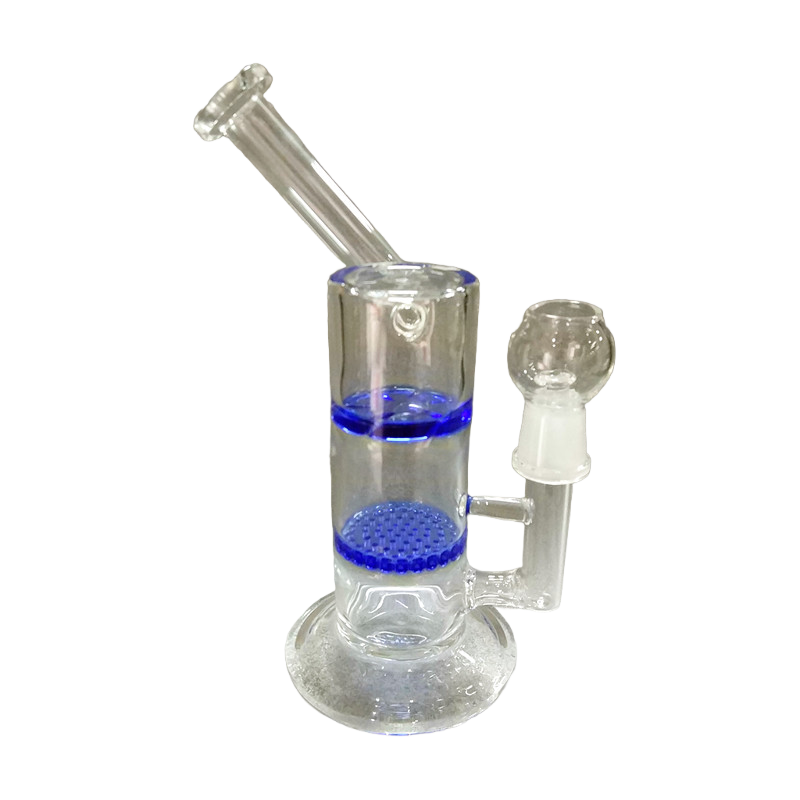
A honeycomb percolator is a flat disc, positioned horizontally inside the chamber, pierced with a dense grid of small holes. Smoke is pressed through the entire disc at once, producing a curtain of fine bubbles. Per opening, this is one of the most efficient diffusion geometries in production glass, and the disc achieves it without any protruding parts.
Manufacturing a honeycomb disc is a different skill from welding arms. The glassworker forms the plate and works the holes while the glass is at working temperature, keeping spacing consistent across the whole surface. The unit is compact and mechanically sturdy — there are no arms to snap — but the hole pattern demands consistency, and a disc with uneven holes diffuses unevenly.
The honeycomb’s weakness shows up after the sale: the dense hole field is difficult to brush clean, and residue buildup inside dozens of small channels is the most common complaint end users bring back to shops. Stock honeycombs where your customers value smooth diffusion and do not mind soaking their piece in cleaning solution.
Matrix Percolators
The matrix percolator looks like a short cylinder or barrel sitting in the chamber, with a grid of holes punched around its sides and sometimes across its top. Smoke enters the barrel and exits through the pattern in every direction at once, which gives matrix percs their characteristic scattered, churning bubble effect.
From the production side, the matrix sits between the tree and the honeycomb in complexity. The barrel itself is one blown unit — no welded appendages — but the hole grid still needs even spacing, and the cylinder walls add glass mass compared with a flat disc. It is a forgiving design to build at volume, which is one reason matrix percs appear across so many mid-range wholesale lines.
Retail-wise, the matrix is a solid middle-of-shelf answer: strong visual percolation, no fragile arms, and cleaning access that is better than a honeycomb but worse than an open inline. If a customer asks for “something smoother than a straight tube but not fussy,” a matrix piece is the honest recommendation.
Inline Percolators
An inline percolator is a horizontal tube with one or more slits or holes running along its length, mounted across the base of the chamber. Smoke enters the tube and vents upward through the slits. The geometry is so simple that inline percs are the backbone of mass-produced water pipes.
Simple, here, is a manufacturing compliment. The inline is one tube, one seal point at each end, and slits cut with a single tool pass. Fewer operations means lower defect exposure and a lower wholesale price at equivalent glass weight. Drag is usually low, because the slits present a wide total opening, and the straight internal passages are the easiest of any perc type to clean with a standard brush.
The trade is character: an inline’s percolation looks functional rather than spectacular, and it diffuses less than a dense honeycomb of similar size. Inlines earn their shelf space as dependable daily-driver pieces — the units a shop sells repeatedly rather than displays.
Showerhead Percolators
The showerhead perc is essentially a single arm ending in a perforated cap, shaped like a shower head. Smoke travels down the arm and sprays out through the holes in the cap. It is one of the oldest designs still in production and one of the cheapest to build: one tube, one cap, one joint.
Because the cap sits well below the waterline and the openings are relatively large, showerhead percs run low on drag and high on reliability. They are also easy to inspect during QC — a hole pattern you can see and count in seconds. For wholesale programs that need a percolated piece at an accessible price point, showerhead builds are usually the first sample we suggest a buyer evaluate.

Percolator Types at a Glance
| Type | Diffusion | Drag | Cleaning access | Build complexity | Stocking fit |
|---|---|---|---|---|---|
| Tree | High (scales with arm count) | Moderate | Moderate — arms obstruct brushes | Highest — multiple welded joints | Premium display pieces |
| Honeycomb | Very high (dense hole field) | Moderate to high | Poorest — pinholes trap residue | Moderate — disc forming + even holes | Diffusion-focused mid/premium |
| Matrix | High (multi-directional) | Moderate | Moderate — barrel interior | Moderate — one blown barrel | Mid-shelf all-rounder |
| Inline | Moderate | Low | Best — straight passages | Lowest — tube + slits | High-volume daily drivers |
| Showerhead | Moderate | Low | Good — open cap | Low — one tube, one cap | Accessible entry percolated pieces |
Read the table by row, not by column. No type wins every category — the buying decision is which column your specific customer weights most, and whether the wholesale price the build complexity implies still leaves you margin at your local price point.
Why Similar-Looking Percs Carry Different Wholesale Prices
Two water pipes can look nearly identical in a catalog photo and sit in different price brackets, and percolator construction is often the reason. Price in production glass follows torch time and yield, and both are set by the perc build.
Count the joints. Every point where one glass component is welded onto another is minutes of skilled hand work plus a place the piece can fail during annealing or QC. A tree percolator with eight arms presents far more joint surface than a single honeycomb disc, so it consumes more bench time and loses more units to weld defects before they ever reach packing. That cost lands on the wholesale quote, not in the spec sheet.
Then count the tolerances. Hole patterns must stay even across the unit or the percolation is lopsided — visible in the water instantly, and visible to a QC inspector just as fast. Dense, small-hole designs (honeycombs) demand more consistent forming than open slits (inlines), and consistency under volume production is exactly what separates a professional line from a cheap one. When you compare quotes between suppliers for the “same” percolator piece, ask what their reject handling is: a factory established in 2010 that runs BSCI, WRAP, and ISO 9001 systems will answer that question concretely; a trader reselling spot goods will not.
See the Water Pipe Range
Percolated beakers, straight tubes, and recyclers — MOQ 100 per design, samples in 1–3 days.
Stock the Glass Pipes Your Customers Actually Buy
Elfglass produces the full wholesale catalog, from hand pipes and sherlocks to dab rigs, percolator bongs, and accessories, in proven best-selling specs. Tell us your market and we will recommend a catalog mix with pricing.
MOQ from 100 pieces | BSCI / WRAP / ISO 9001 | NDA before every project
What This Means for Your Shelf: Stocking Logic
The practical question for a buyer is not which percolator is best — it is which mix fills your shop’s roles. Pipe size splits demand the same way: our guide to mini vs full-size water pipes breaks down how each bracket sells. A workable first allocation looks like this:
- Volume slot: inline or showerhead pieces. Low drag, easy cleaning, low defect exposure. These are the units that reorder themselves.
- Mid slot: matrix or single-honeycomb pieces. Noticeably denser diffusion, still one-unit builds, priced for the customer stepping up from their first pipe.
- Display slot: tree percs and multi-chamber designs. These earn their margin through presence and perceived craft; stock them shallow and pack them carefully.
Breadth matters more than depth on a first order, because you are buying information as much as inventory. Before you lock the mix, compare the actual builds side by side in our water pipe product range — percolator styles are easier to judge from real photos and specs than from a quote sheet. With an MOQ of 100 pieces per design, a trial order can carry five percolator styles at 20 pieces each and tell you which one your customers actually lift off the shelf. Sampling runs in 1–3 days and bulk production in 7–12 days for orders of 100 or more, so the cost of testing a perc type you have never stocked is one small order, not a season of dead stock. Our guide to MOQ 100 trial orders walks through that structure in detail, and our walkthrough of the rig styles moving this year shows how style trends shift the same stocking math.
One caution on multi-perc pieces: stacking two or three percolators in one chamber multiplies diffusion but also drag and failure points. For most retail customers, one well-made percolator outperforms two mediocre ones. If a design impresses you in a sample, ask the factory how the chambers drain and how the piece cleans before you order it at volume.
Cleaning, Returns, and the After-Sales Reality
Percolator choice echoes into your after-sales workload, and most buyers never price that in. The question to ask about any perc design is simple: can a standard cleaning brush physically reach every surface the smoke touches?
Inlines pass that test almost by default — straight tubes take a brush end to end. Showerhead caps are open enough to scrub or soak without effort. Matrix barrels are workable if the mouth is wide. Honeycombs and tight tree arms are where residue accumulates out of reach, and that is where “my pipe got dirty and I can’t clean it” becomes your counter conversation six weeks after the sale.
An ash catcher mounted between the bowl and the bong stops embers and ash before they reach the water column, which keeps the water cleaner and slows downstem slit clogging between deep soaks — the wholesale ash catcher guide covers joint sizes, perc styles, and the add-on math, and our breakdown of ash catcher benefits explains how this add-on keeps the main piece cleaner between soaks.
This is also where a splash guard earns its keep on high-diffusion pieces: dense percolation throws more water around, and a poorly placed guard or an overfilled chamber turns diffusion into a wet mouthpiece complaint. When you evaluate samples, fill them to the working line and check splash behavior before you sign off — it takes two minutes per piece and predicts a season of reviews. And when you do reorder a proven design, keep the approved sample photos with the order file; if delivered units drift from what you approved, that record anchors the conversation with the factory.
Can You OEM a Custom Percolator Design?
Yes — custom percolator geometry is standard OEM territory, within manufacturing limits. A factory with in-house OEM/ODM capability can adapt arm counts, hole patterns, and chamber layouts from your drawings, and a custom mold built for your design stays exclusive to you rather than reappearing in a competitor’s catalog. The same commercial structure applies as any OEM project: NDA before the project starts, sampling in 1–3 days, and production MOQ of 100 pieces per design. If your house style is a proprietary perc layout, that exclusivity is a genuine moat — customers cannot price-match your piece against an identical listing elsewhere.
Frequently Asked Questions
Which percolator type is best for a first wholesale order?
Start with breadth, not a single “best” type: inline or showerhead pieces for the volume slot, a matrix or honeycomb for the mid slot, and one tree-perc display piece. At MOQ 100 per design you can test all three roles in one trial order and let your sales data decide the reorder.
Do more percolators automatically mean better filtration?
Not automatically. Each added percolator increases diffusion surface but also adds draw resistance, splash risk, and another glass joint that can fail. One well-designed percolator matched to the chamber usually serves retail customers better than two or three stacked units.
Which percolator is easiest for customers to clean?
Inline percolators are the easiest — straight passages take a brush end to end, and showerhead caps follow closely. Honeycomb discs are the hardest because residue traps inside the dense pinhole field. If cleaning complaints matter in your market, weight the shelf toward inlines.
Why do tree percolator pieces cost more wholesale?
Each arm is a separate hand-welded joint, so tree percs consume more torch time and lose more units to weld defects than single-unit percs like honeycombs or inlines. The higher wholesale price reflects that labor and that yield, not just the glass weight.
Can we order a custom percolator design with our branding?
Yes. OEM/ODM projects can modify perc geometry from your drawings, with the custom mold kept exclusive to your brand. Standard terms apply: NDA before the project, sampling in 1–3 days, and MOQ of 100 pieces per design.
Percolators are a small component with an outsized effect on how a water pipe performs, prices, and sells. Judge them the way a builder does — by joints, tolerances, and cleaning access — and your shelf will stock filtration that your customers can feel and your margins can survive. If you are stocking a new range, start a conversation with our team and we will shortlist perc configurations that fit your price points.
Get a Quote for Your Next Order
Building your wholesale lineup? with perc setups matched to how your customers smoke? Explore our wholesale water pipe collections for MOQ, tiered pricing, and factory-direct lead times. Send us your product spec and target quantity — contact our factory team or message us on WhatsApp, and we will reply with pricing and lead times within 24 hours.
Percolators are only one part of a well-stocked shelf. Browse our wholesale parts and accessories for the downstems, bowls, and add-ons retailers reorder most.
About the Author
Ava Zeng is the founder of Elfglass, a Shenzhen-based borosilicate glass pipe manufacturer serving B2B brands worldwide. Every guide on this site is grounded in her production-floor experience— the annealing lines, QC checkpoints, and export orders behind each claim.
Before you commit to a supplier, read her founder’s story and trust promise, and the guide to vetting a reliable glass pipe manufacturer— the same red-flag checklist Elfglass applies to its own suppliers.
Perc-type comparisons reference the diffusion classifications in percolator design, where hole count and chamber geometry affect filtration efficiency.
Ready to Source Custom Glass Pipes?
Get a free quote within 24 hours. MOQ from 100 pieces. NDA-protected design consultation.
