
The cheapest way to pay a glass pipe supplier is almost never the safest, and the difference between the two can be an entire shipment. Buyers fixate on the fee line — a few dollars for a wire, a few percent for a card — and treat payment terms as an accounting detail. They are not. Payment terms decide who is holding the risk at each step of a cross-border order: your money, or their glass. Choose wrong and a delayed, damaged, or simply never-shipped container turns a low fee into a total loss.
Seen properly, every payment method is a slider between three things: risk, cost and speed. A telegraphic transfer is cheap and fast but leaves a buyer exposed before shipment. A letter of credit shifts risk to a bank but adds fees and paperwork. PayPal is instant and protected but expensive. There is no universally correct answer — only the right setting for your order size, your relationship with the factory, and how much recourse you need if something goes wrong.
This guide compares the six methods a glass pipe importer will actually meet, scored on risk, cost and speed, and ends with a decision framework so you know which to ask for. We have run T/T terms with buyers since 2010 at Elfglass, and this is exactly how we brief new customers on structuring an order. One note first: this is practical trade orientation, not financial or legal advice — for large or unusual deals, confirm terms with your bank or a trade advisor.
Glass pipe suppliers most commonly use a telegraphic transfer (T/T) split 30 percent deposit before production and 70 percent balance before shipment. Letters of credit add bank-backed security for large first orders, PayPal and cards suit samples, Alibaba Trade Assurance offers escrow on-platform, and net terms reward established relationships. Choose by weighing risk, cost and speed, not fees alone.
Key Takeaways
- Payment terms are a risk decision, not a fee decision — decide who holds exposure at each step.
- T/T 30/70 (30 percent deposit, 70 percent before shipment) is the China wholesale standard.
- A letter of credit (L/C) under ICC UCP 600 gives bank-backed security but adds cost and paperwork.
- PayPal and cards are fast and buyer-protected but the most expensive; best for samples.
- Alibaba Trade Assurance holds payment in escrow, but only for orders kept inside the platform.
- Net 30/60 terms reward trust; Western Union is fast but offers little recourse for a first deal.
Table of Contents
Payment Terms Are a Risk Decision

Start by asking one question of every method: at the moment money changes hands, who is exposed if the other side does not perform? Pay 100 percent up front by wire and the buyer carries all the risk until the goods arrive. Pay nothing until the goods are inspected at destination and the seller carries it. Every structure in between is a negotiated split of that exposure. The fee you pay for a method is really the price of moving risk from one party to the other — or to a bank.
This reframing explains why a supplier’s “cheapest” option and a buyer’s “safest” option are rarely the same. A factory prefers cash before it spends on materials and labor; a buyer prefers to pay only when glass is in hand. Payment terms are where those two preferences meet, and the right answer depends on order size, trust, and how much protection each side needs. Evaluating a supplier’s willingness to meet you on terms is part of vetting them overall — our supplier scorecard template includes payment flexibility as a scoring criterion.
| If You Pay… | Buyer Risk | Seller Risk | Typical Use |
|---|---|---|---|
| 100% before production | Highest | Lowest | Rare; large trusted repeat orders |
| 30/70 T/T | Moderate | Moderate | The standard for most wholesale |
| Against documents (L/C) | Low | Low | Large or first orders |
| After delivery (net terms) | Lowest | Highest | Established relationships |
T/T (Telegraphic Transfer) 30/70: The Default
A telegraphic transfer — T/T, in practice an international bank wire transfer — is the workhorse of glass pipe sourcing. The standard structure is 30 percent deposit before production begins and 70 percent balance before the goods ship. The deposit gives the factory confidence and working capital to buy materials; the balance before shipment means the buyer’s full money is not at risk for the entire production window, and the seller is paid before losing control of the goods.
T/T is cheap and fast: bank wire fees are low and typically flat regardless of order size, and money arrives in one to three business days. Its weakness is that the split is built on trust, not on a bank guarantee. The buyer sends the 70 percent before physically seeing the finished container, and the seller ships only after that money clears. For this reason T/T works best once a relationship exists, or when the order is small enough that the exposure is survivable. It is the structure Elfglass uses, and the one most buyers will be offered first.
Two practices de-risk a T/T order. First, tie the balance payment to evidence — photos or a video of the finished, packed goods, or a third-party inspection report — so you pay the 70 percent against proof the order is correct. Second, keep the deposit as small as the factory will accept on a first order. Negotiating these points is normal and expected; our guide to switching glass pipe suppliers covers how to open that conversation without damaging the relationship.
Want Clear, Low-Risk Payment Terms?
Elfglass works on transparent T/T 30/70 terms, provides production photos and video before your balance is due, and signs an NDA before every OEM project. Send your product list and get a quote — including payment terms — within 12 hours.
MOQ from 100 pieces | BSCI / WRAP / ISO 9001 | Quote in 12 hours
Letter of Credit (L/C): Bank-Backed Security
A documentary letter of credit replaces trust with a bank’s promise. Under an L/C, the buyer’s bank undertakes to pay the seller a defined sum, but only against a defined set of compliant shipping documents — typically a bill of lading, commercial invoice, packing list and any inspection or insurance certificates the terms name. If the documents match, the bank pays; if they do not, it does not. The governing rules are the ICC’s Uniform Customs and Practice for Documentary Credits (UCP 600), the international standard published by the International Chamber of Commerce.
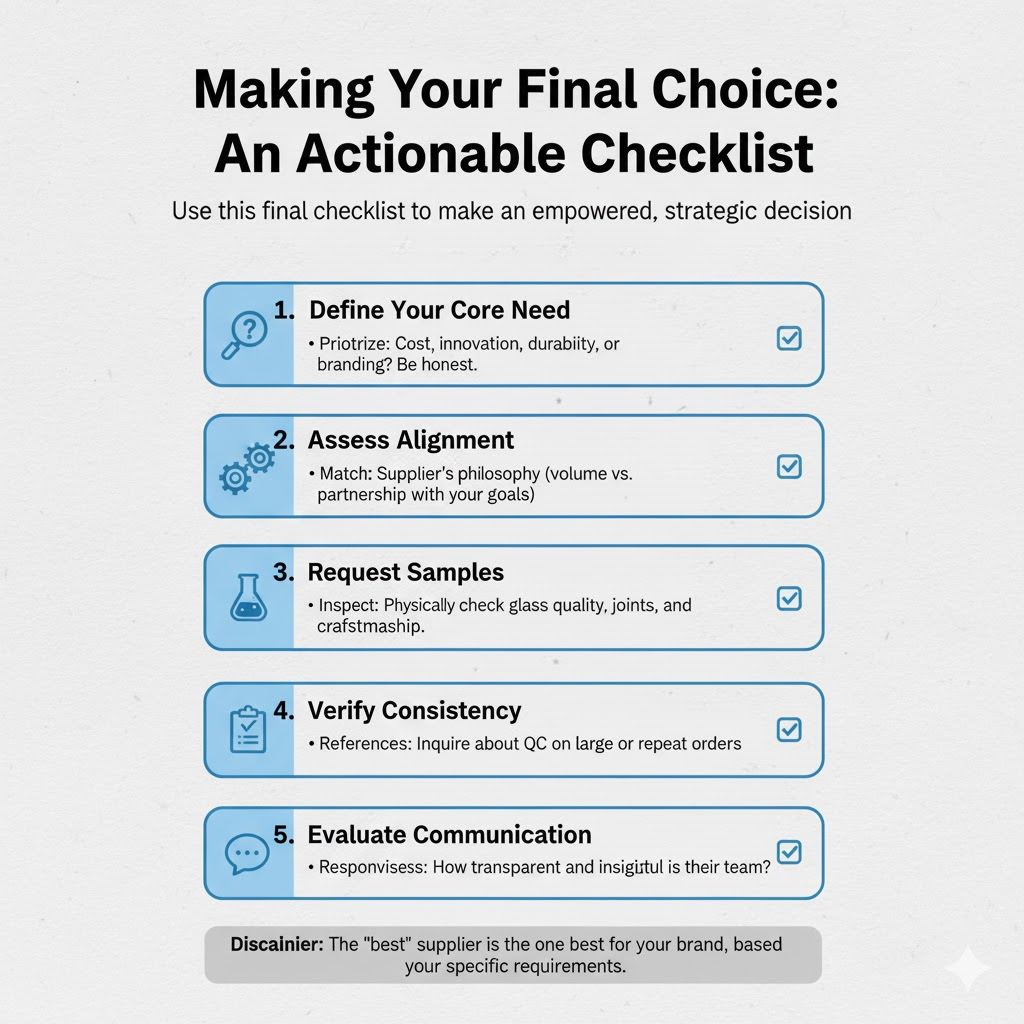
The security is real but narrow. An L/C protects the buyer from paying for goods that never ship, because the bank only pays against proof of shipment; it protects the seller because a creditworthy bank, not the buyer, stands behind payment. What it does not do is guarantee quality — a bank examines documents, not glass. A container of chips and cracks with perfect paperwork still gets paid. For that reason an L/C should name a pre-shipment inspection certificate among its required documents, so payment is conditional on an independent check of the goods too.
The costs are higher: issuing, advising and negotiating bank charges, plus the labor of producing documents that match the credit letter-for-letter, because any discrepancy lets the bank delay or refuse payment. Because of that overhead, L/C makes sense for large orders or a first deal with an unknown supplier where the amounts justify the protection — not for a small reorder from a factory you already trust, where T/T is simpler and cheaper.
PayPal and Card Payments
PayPal and credit-card routes are the fastest and most buyer-friendly methods, and the most expensive. PayPal offers dispute and purchase protection, money moves almost instantly, and there is no bank paperwork — which makes it the natural choice for samples, small trial orders, or paying for a design consultation. For a first-time buyer who wants recourse on a modest amount, that protection is worth a great deal.
The trade-off is cost and seller resistance. PayPal and card fees run as a percentage of the transaction, so on a five-figure bulk order the fee alone can dwarf a flat wire charge, and the seller often loses that margin. Sellers also fear chargebacks: a buyer can dispute a card or PayPal payment after receiving goods, and the funds can be reversed. That is why most factories accept PayPal for sampling but ask for T/T or L/C on production. Use PayPal where speed and protection matter more than the fee — small, early, or high-trust-risk transactions — and move to a bank method once volume grows.
Alibaba Trade Assurance and Escrow
Escrow splits the difference: a trusted third party holds the buyer’s money and releases it to the seller only when agreed conditions are met. The best-known version in this space is Alibaba Trade Assurance, which protects orders placed and paid on Alibaba against a supplier missing the agreed shipping date or product terms, and lets the buyer open a dispute for review. Because the platform stands between the two parties, a first-time buyer gets more recourse than a bare T/T offers.
The important limitation is the boundary: Trade Assurance covers only transactions that stay inside the platform’s payment system. If a supplier persuades you to move the conversation off-platform and pay by direct wire to “save fees,” you lose that protection entirely — a common pressure tactic and a red flag on a first order. Independent escrow services exist outside Alibaba on the same principle. Escrow is a sensible middle path for a first platform order; just keep the payment where the protection lives.
Net Terms and Western Union
Net terms — net 30, net 60 — let an established buyer receive goods and pay an invoice a set number of days later. They are the most buyer-friendly structure of all, because payment follows delivery, and they usually require the seller to have real confidence in the buyer’s creditworthiness. In cross-border wholesale, net terms are rare on a first order and typically emerge only after a track record, or are backed by trade credit insurance. If a supplier offers you net terms, treat it as a sign the relationship has matured.
At the other end sits money-transfer services like Western Union. They are fast and reach places banking is thin, which is why some suppliers request them for small or urgent payments. But a money transfer is essentially cash: once picked up, it is very difficult to reverse, and there is little formal recourse if the goods never arrive. Reserve it for small amounts with a supplier you already know well — never for a large first order, where an L/C or escrow is the appropriate protection.
The Methods Compared
Laid side by side, the trade-offs are clear. No method wins on all three axes; each buys an advantage in one dimension at a cost in another. The right choice is the one whose weakness you can afford for the specific order in front of you.
| Method | Buyer Risk | Cost (Fees) | Speed | Best For |
|---|---|---|---|---|
| T/T 30/70 | Moderate | Low (flat wire fee) | Fast (1-3 days) | Most wholesale, repeat orders |
| Letter of Credit | Low | Higher (bank charges) | Slower (paperwork) | Large or first orders |
| PayPal / Card | Low | Highest (percentage) | Instant | Samples, small trial orders |
| Alibaba Trade Assurance | Low-Moderate | Moderate | Fast | First orders on-platform |
| Net 30/60 | Lowest | Low | Delayed | Established relationships |
| Western Union | High | Moderate | Fast | Small, urgent, known suppliers |
How to Choose Your Terms
With the comparison in hand, the decision reduces to a few practical questions: how large is the order, how well do you know the supplier, and how much recourse do you need if it goes wrong. Here is the framework we use with buyers, ordered from a first contact to a long-term partnership.
| Scenario | Recommended Terms | Why |
|---|---|---|
| Paying for samples | PayPal or card | Small amount, speed and protection matter most |
| First bulk order, unknown supplier | L/C or Alibaba Trade Assurance | Bank or platform stands between you until trust is built |
| First bulk order, vetted supplier | T/T 30/70 with pre-shipment photos or inspection | Lower cost than L/C, deposit protects the factory, evidence protects you |
| Repeat order, trusted supplier | T/T 30/70 | Relationship reduces risk; keep it cheap and simple |
| Mature relationship, strong track record | Net terms | You have earned payment-after-delivery trust |
Two rules cut across every scenario. First, never move a protected transaction off-platform to “save fees” — you are trading a small saving for all of your recourse. Second, match the protection to the exposure: the more money and the less trust, the more you should lean on a bank, a platform, or an inspection clause rather than goodwill.
Payment terms are also negotiable, and the way a supplier responds tells you a lot about them. A factory that will tie your balance to inspection evidence, sign an NDA, and explain its terms plainly is signaling it intends the relationship to last. If you are ready to agree terms on a real order, request a quote with your product list — we will respond within 12 hours and lay out the T/T structure, sampling and any documentation you need. For how terms interact with shipping responsibility, see our guide to the best Incoterms for importing glass pipes.
What are the standard payment terms for glass pipe suppliers?
The most common structure in China wholesale is a telegraphic transfer (T/T) split as 30 percent deposit before production and 70 percent balance before shipment. It balances the factory’s need to fund materials against the buyer’s wish to pay most of the money only when the goods are ready. Elfglass uses exactly this T/T 30/70 structure.
Is a letter of credit safer than T/T?
For the buyer, a letter of credit can be safer because a bank pays only against compliant shipping documents, so you are not sending cash before the goods move. The trade-off is cost and paperwork: bank charges are higher and any document discrepancy can delay payment. L/C suits large first orders; T/T suits smaller or repeat business.
Can I pay a glass pipe supplier with PayPal?
Yes for samples and small orders. PayPal is fast and offers buyer protection, but its fees are the highest of the common methods and sellers often resist it for bulk because of chargeback risk and cost. Most factories prefer PayPal only for sampling, then move to T/T or L/C for production orders.
What is Alibaba Trade Assurance?
It is an escrow-style protection built into orders placed and paid on Alibaba. Your payment is held and released against agreed order and shipping terms, and you can open a dispute if the supplier misses them. It lowers buyer risk on a first platform order but only covers transactions kept inside Alibaba’s system.
Which payment method is cheapest?
On pure fees, a bank T/T is usually the cheapest for bulk because wire fees are low and flat. PayPal and card routes cost the most as a percentage. A letter of credit adds bank charges but reduces risk. The cheapest method on paper is not always the best value once you weigh the risk of a shipment going wrong.
Ready to Start Your Custom Glass Pipe Project?
Get a free quote within 24 hours. MOQ from 100 pieces. NDA-protected design consultation.
