
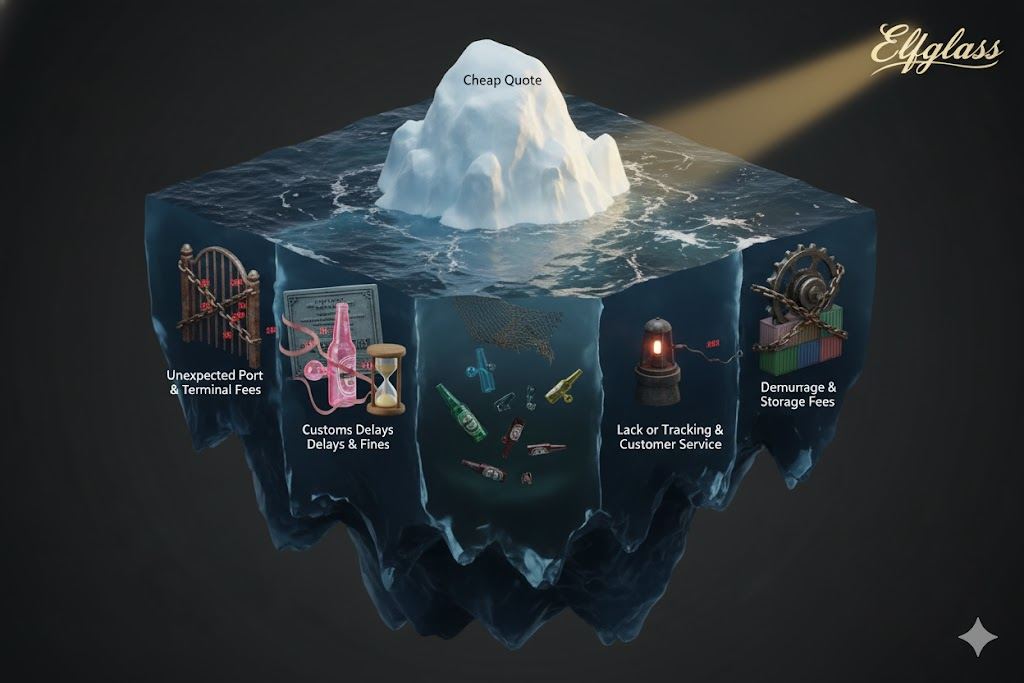
Three letters on a quote decide more about your profit than the unit price does. Buyers haggle over cents per pipe while signing past the Incoterm — the code that fixes who pays the freight, who clears customs, who carries the insurance, and, for fragile glass, who eats the loss when a crate arrives cracked. Get the price right and the term wrong and you have still bought an expensive shipment.
An Incoterm is not a shipping method; it is an allocation of cost and risk between you and the factory. Understood that way, the choice stops being mysterious. At Elfglass we quote FOB as standard and explain exactly where our responsibility ends, because a buyer who knows the risk transfer point is a buyer who does not dispute a claim six weeks later.
For most glass pipe imports, FOB is the safest default: the factory clears export and loads the goods, then you control freight, insurance, and the risk from the origin port. Choose CIF only if you accept minimum cover, DAP if you want door delivery but will clear customs yourself, and DDP only when a supplier genuinely offers duty-paid delivery.
Key Takeaways
- An Incoterm allocates cost and risk — it is not a price and not a shipping method.
- Risk transfer is the key line for fragile glass: know exactly where breakage becomes yours.
- FOB is the standard default from China: seller clears export and loads, buyer controls the voyage.
- CIF looks easy but risk still transfers at origin, and the insurance is often bare-minimum cover.
- Compare suppliers on landed cost, never on the headline Incoterm price — the terms hide different bills.
Table of Contents
What an Incoterm Actually Decides
Every Incoterm answers four questions, and only four. Who arranges and pays the main carriage? Who handles export and import customs clearance? Who pays the duty and taxes? And the one that matters most for glass: at what precise physical point does the risk of loss or damage pass from seller to buyer? Price is negotiated separately — the Incoterm tells you which of those four buckets each party owns.
The risk-transfer point is the one buyers skip, and it is the one that decides who files the insurance claim when a pallet of bongs arrives shattered. Under some terms risk passes at the factory gate; under others it passes at your warehouse. Same broken glass, completely different conversation about who pays for it. The current rules are published by the International Chamber of Commerce as Incoterms 2020; the eleven terms are standardized worldwide so a FOB in Shanghai means the same as a FOB in Hamburg.

The Five Terms Glass Buyers Actually Use
Incoterms 2020 lists eleven terms — the full set is catalogued in the Incoterms reference — but sea-freight glass imports run on five. Here is the whole decision in one table before the detail.
| Term | Risk transfers at | Seller pays | Buyer pays | Best for |
|---|---|---|---|---|
| EXW | Factory gate | Nothing but making goods ready | Export, freight, insurance, duty | Buyers with a China agent |
| FOB | Loaded on vessel at origin | Export clearance + loading | Freight, insurance, duty | Most importers (default) |
| CIF | Loaded on vessel at origin | Freight + min. insurance | Import duty, on-carriage | Buyers wanting one price |
| DAP | Your named place | Freight to your door | Import clearance + duty | Simple door delivery |
| DDP | Your named place | Everything incl. duty | Nothing but unloading | Turnkey, priced with risk |
Notice that FOB and CIF share the same risk-transfer point — loaded on the vessel at origin — even though CIF looks like it covers more. That single fact causes most of the confusion below. For the plain-language version of these codes as a supplier writes them, see our FOB, EXW, and DDP explainer for importers.
EXW vs FOB: Where the Default Sits
EXW (Ex Works) is the minimum the seller can do: make the goods available at the factory and nothing else. You arrange collection, export clearance, loading, freight, insurance, and duty. On paper it gives the cheapest quote; in practice it hands a foreign buyer a pile of Chinese logistics problems they are poorly placed to solve. Export clearance from China in particular is awkward for an overseas entity without a local agent.
FOB (Free On Board) moves the export side onto the seller, which is why it is the working default for China glass imports. The factory clears the goods for export and loads them onto the vessel at the named port; from that rail onward, freight, insurance, and risk are yours. You keep control of the main carriage — your forwarder, your rates, your insurance level — without inheriting Chinese export paperwork.

The verdict for a first-time importer: quote FOB with a named port (FOB Shenzhen, FOB Ningbo) and appoint your own freight forwarder. It gives you the control of EXW over the voyage without the headache of Chinese export clearance. Only choose EXW if you already have a trusted China-based sourcing agent who consolidates and clears for you.
CIF and the Insurance Illusion
CIF (Cost, Insurance and Freight) is popular because it looks like one tidy price: the seller pays freight and insurance to your destination port. Buyers read “insurance included” and relax. Two catches sit under that comfort. First, risk still transfers at origin — once the goods are loaded on the vessel, damage in transit is your problem, not the seller’s, even though the seller bought the policy. Second, CIF only obliges the seller to minimum cover (Institute Cargo Clauses C), which excludes a lot of what actually goes wrong with glass.
So a CIF shipment of bongs that arrives cracked is your claim to file, on a policy the seller chose at the cheapest level. If you want real protection you either take FOB and insure it yourself at a proper all-risk level, or explicitly negotiate higher cover under CIF and get it in writing. For fragile goods the difference between minimum and all-risk cover is the difference between a paid claim and a shrug.
CIF is fine when you understand it: a single delivered-to-port price, seller-arranged carriage, buyer-owned voyage risk, minimum insurance unless you upgrade it. It is a trap only when a buyer assumes the seller still owns the goods until they reach the destination port. They do not.
Want a Quote With the Incoterm Spelled Out?
Every Elfglass quote names the Incoterm and the exact port or place, so you always know where our cost and risk end and yours begin. Send your design and quantity for an itemized FOB or CIF price within 12 hours.
MOQ from 100 pieces | Named-port FOB | Quotes in 12 hours
DAP and DDP: Delivered to Your Door
DAP (Delivered At Place) and DDP (Delivered Duty Paid) both put the goods at your named address, and they differ on one line: import customs. Under DAP the seller delivers to your door but you clear import customs and pay the duty and taxes. Under DDP the seller does everything, including clearance and duty, and you simply receive the goods.
DDP sounds ideal — one price, zero hassle — and it is why buyers ask for it. It is also rare from China and priced accordingly, because the seller is taking on your country’s duty rates, customs risk, and clearance delays without controlling them. When a supplier does offer DDP, check whether the number is realistic or padded with a heavy risk premium; a genuine DDP requires the seller to know your HS code and duty rate precisely. Our import duties by country guide shows how wide those rates vary, which is exactly why sellers are cautious about DDP.
DAP is the honest middle ground for buyers who want door delivery but have a customs broker. You get the goods delivered, you control the duty line through your own broker, and nobody has to guess your tax rate. For most importers comfortable with a broker, DAP beats a padded DDP.
How the Incoterm Changes Landed Cost
Here is the commercial reason the term matters: the same physical shipment produces a different landed cost depending on which bills are inside the quote and which arrive separately. A cheap FOB number plus your own freight can land lower than a CIF number that bundles carriage at a rate you cannot check — or higher, if your forwarder is expensive. The only fair comparison is landed cost.
| Cost line | EXW | FOB | CIF | DAP | DDP |
|---|---|---|---|---|---|
| Goods | You | You | You | You | You |
| Export clearance | You | Seller | Seller | Seller | Seller |
| Main freight | You | You | Seller | Seller | Seller |
| Insurance | You | You | Seller (min) | You | Seller |
| Import duty | You | You | You | You | Seller |
| On-carriage to door | You | You | You | Seller | Seller |
To compare two suppliers quoting different terms, convert both to the same landed-cost basis before you decide. Add your own freight and insurance to a FOB quote, or strip the seller’s bundled carriage out of a CIF quote, until both numbers represent goods sitting in your warehouse with duty paid. Our markup calculator then runs on that true landed cost, and cost of importing from China walks the full stack. The hidden shipping costs guide lists the surcharges that quietly change the winner.
Which Incoterm Should You Choose?
The decision is not which term is best in the abstract; it is which one fits your experience, your lane, and how much control you want. Work through this checklist in order.
- First import, no China agent? Use FOB with a named port and your own forwarder. The seller handles export; you control freight and insurance.
- Have a trusted China sourcing agent? EXW can save money, because the agent consolidates and clears export for you.
- Want one tidy price to a port and accept minimum cover? CIF — but negotiate all-risk insurance in writing for glass.
- Have a customs broker and want door delivery? DAP: seller delivers, you clear and pay duty through your broker.
- Want true turnkey and the seller genuinely offers it? DDP — verify the duty assumption behind the price before you trust it.
For fragile glass specifically, weight the risk-transfer point heavier than the headline convenience. A term that leaves breakage in transit on your side of the line demands that you control the insurance — which usually pushes serious buyers back to FOB with proper cover rather than CIF with minimum cover.
Four Incoterm Mistakes on Fragile Freight
These four errors recur on glass shipments, and each one is avoidable with a sentence in the contract.
- Assuming CIF insures you to the door. Risk transfers at origin and cover is minimum by default. If you want all-risk protection, name it in the contract or insure the voyage yourself.
- Accepting a DDP quote without checking the duty math. A padded DDP hides a guessed duty rate. Ask which HS code and rate the seller assumed, then verify against the duties guide.
- Quoting FOB without naming the port. “FOB” alone is ambiguous — FOB Shenzhen and FOB Shanghai are different trucking and timing costs. Always name the port.
- Ignoring risk transfer on breakage. Know the exact point damage becomes yours and match your insurance to it. For glass this is the whole game.
One quieter mistake: choosing the term before choosing the payment structure. The Incoterm and the payment terms interact — a DDP shipment tied to an open account is a very different risk from FOB with a staged deposit. Our T/T payment terms guide and Trade Assurance vs T/T comparison cover the money side that sits alongside the term.
Conclusion
The best Incoterm for importing glass pipes is the one whose risk-transfer point you understand and whose cost lines you can verify. For most buyers that is FOB from a named Chinese port with your own forwarder and proper insurance. CIF works if you accept minimum cover or negotiate it up; DAP suits buyers with a broker who want door delivery; DDP is turnkey convenience priced with risk; and EXW only makes sense with a China agent in place.
Your decision checklist:
- Name the term and the place — FOB Shenzhen, DAP Los Angeles — never the code alone.
- Mark where risk transfers; for glass, match your insurance to that exact point.
- Convert every quote to landed cost before comparing suppliers.
- Under CIF, upgrade minimum cover to all-risk in writing.
- Under DDP, verify the duty rate and HS code the seller assumed.
- Align the Incoterm with your payment terms before you sign.
Ready to price a real lane? Request a quote that names the Incoterm and the port, and you will see exactly where our cost ends and your landed-cost stack begins.
What is the best Incoterm for importing glass pipes from China?
For most first-time importers, FOB is the safest default: the factory handles export clearance and loading, and you control freight and insurance from the origin port. It balances control with a manageable seller obligation.
Does CIF mean the seller insures my goods to my door?
No. Under CIF the seller pays freight and minimum insurance to the destination port, but risk transfers to you once the goods are loaded at origin. You own the voyage risk, and the cover is often the bare minimum.
What is the difference between DAP and DDP?
Both deliver to your door, but under DAP you clear import customs and pay duty, while under DDP the seller handles clearance and duty. DDP is convenient but priced with a risk premium and is rare from China.
Which Incoterm puts the most responsibility on the buyer?
EXW. The seller only makes goods available at the factory; you handle export clearance, loading, freight, insurance, and import duty. It is hard to run from another country and rarely worth it for glass.
Does the Incoterm change my landed cost?
Yes. The same goods under different Incoterms shift freight, insurance, and duty between the quote and your own bills. Compare quotes on landed cost, never on the headline Incoterm price.
Ready to Start Your Custom Glass Pipe Project?
Get a free quote within 24 hours. MOQ from 100 pieces. NDA-protected design consultation.
