
You requested a custom glass pipe sample. The supplier said yes, but there is a sample fee. Now you are staring at an invoice for a prototype you have not even held in your hands yet, and the real question is not whether the fee exists. It is what happens to that money afterward. Does it come back to you? Does it count toward your first bulk order? Or does it disappear the moment the sample ships? The ICC’s Incoterms® rules standardize how responsibility and risk split between buyer and seller in international trade (Incoterms rules).
This is one of the most common friction points in B2B glass pipe sourcing, and it sits right at the intersection of trust, cost management, and supplier evaluation. Every manufacturer has a sample fee policy, but very few of them explain it clearly upfront. The result is that buyers either overpay silently, walk away from legitimate suppliers over misunderstandings, or fail to negotiate terms that protect their investment.
This guide breaks down the three dominant sample fee models used across the glass pipe manufacturing industry: refundable deposits, credits applied against future orders, and sunk costs. By the end, you will know exactly which model you are looking at, how each one affects your total project cost, and what leverage you have to negotiate better terms before committing to a production run.
Why Manufacturers Charge for Custom Samples
Before evaluating whether a sample fee policy is fair, it helps to understand what the fee actually covers. A custom glass pipe sample is not pulled from a warehouse shelf. It is a one-off production event that requires the same materials, the same labor, and often the same tooling as a full production run, just at dramatically lower volume.
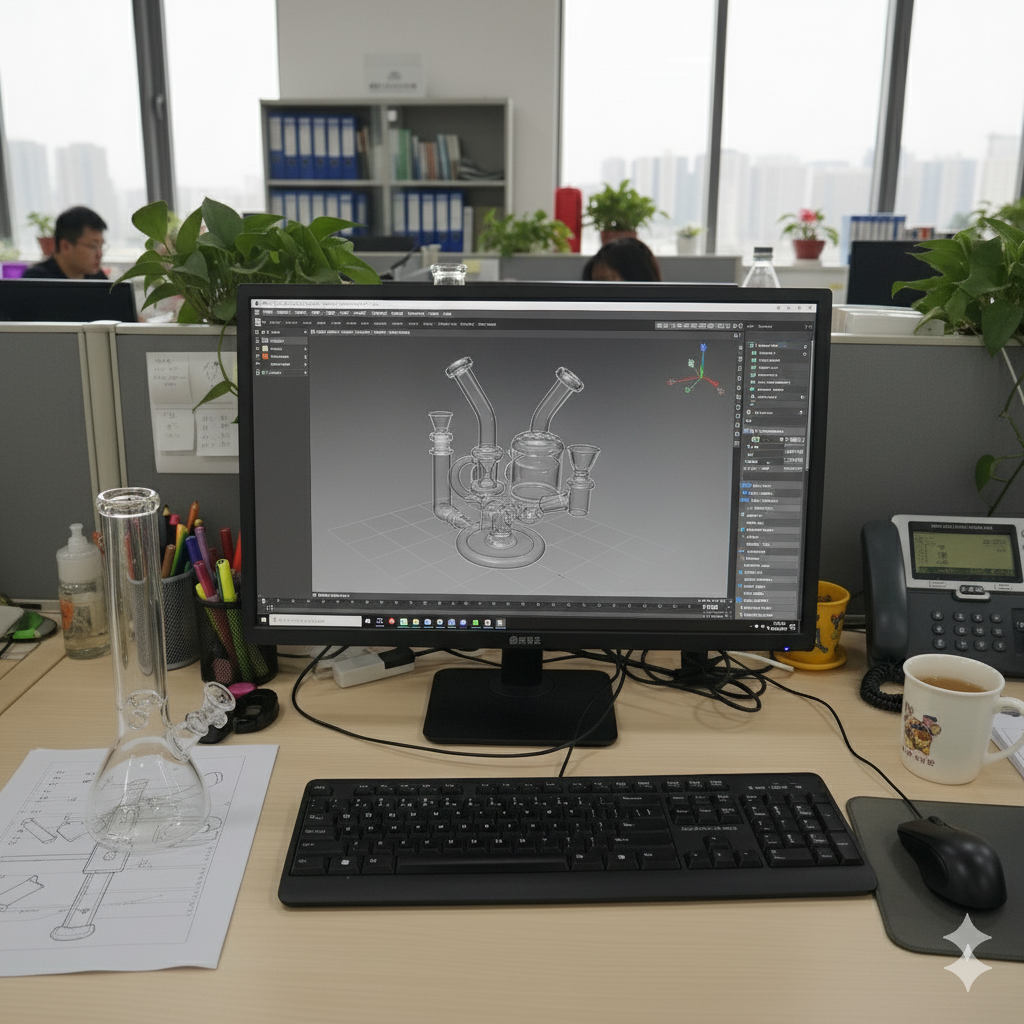
Consider what goes into a single custom sample. The factory must set up borosilicate glass rods or tubing specific to your design. A glassblower or production technician dedicates time to blowing, shaping, and annealing a piece that will never be sold at retail. If your design requires a custom mold, that mold must be fabricated first. If you want your logo engraved or a specific color matched, those setup steps happen regardless of whether the order is one piece or one thousand.
The economics are straightforward. A factory running 100 units of your design spreads its setup cost across all 100. A factory running one unit bears 100 percent of that setup cost on a single item. The sample fee exists to cover that disproportionate cost and to signal that the buyer is serious enough to move toward production.
Some suppliers, particularly larger operations or trading companies, absorb basic sample costs as a sales expense. They send existing catalog items for free, hoping the sample converts into a wholesale order. Browse our product catalog to see which standard designs are typically sent as no-cost samples. But when you need a custom design, a specific color formulation, a branded logo placement, or a completely new mold, the calculus changes. The supplier is investing real production capacity into a prototype that may never lead to a bulk order. The sample fee policy is how they manage that risk.
The Three Sample Fee Models in Glass Pipe OEM Manufacturing
Across the borosilicate glass pipe industry, sample fee policies cluster into three distinct models. Each one handles the buyer’s financial risk differently, and each one signals something about how the supplier views the relationship. Understanding these models is essential whether you are sourcing your first custom hand pipe or expanding an existing product line with new designs.
Model 1: Fully Refundable Deposit
Under this model, the buyer pays the sample fee upfront, and the supplier refunds the full amount once a qualifying bulk order is placed and paid for. The refund is typically issued as a direct payment back to the buyer, though some suppliers apply it as a credit on the invoice rather than returning cash.
The refundable deposit model is the most buyer-friendly structure available. It effectively makes the sample free, provided you follow through with production. The supplier absorbs the cost of sampling as a customer acquisition investment, and the buyer’s financial exposure is limited to the time value of the money tied up between the sample payment and the refund.
This model tends to appear when the supplier is confident the design will convert to production, when the sample cost is relatively low, or when the supplier is actively competing for your business and using refundable terms as a differentiator. It is common for samples based on existing catalog designs with minor modifications, such as a color change or logo addition, where the factory’s incremental cost is minimal.
The key detail to watch is the threshold. Some suppliers require the bulk order to meet a specific quantity, such as the standard MOQ of 100 pieces per design, before the refund triggers. Others set a minimum dollar value on the order. Clarify this threshold in writing before you pay.
Model 2: Credit Against Future Orders
The credit model is the most common structure in glass pipe OEM manufacturing. The buyer pays the sample fee upfront. When a bulk order is placed, the sample fee is deducted from the production invoice as a credit memo. The money does not come back as a separate refund; it reduces what you owe on the production run.
This model aligns the interests of both parties. The supplier knows the buyer has skin in the game, which filters out casual inquiries from people who have no intention of placing a production order. The buyer, in turn, recovers the sampling investment as soon as they commit to volume. The sample effectively becomes an advance payment on the first production run.
Credit terms vary. Some suppliers apply the full sample fee as a credit. Others apply a percentage, keeping a portion as a non-recoverable setup fee. The split often depends on the complexity of the sample. A simple color swap on an existing design might get full credit, while a completely new glass pipe shape requiring a custom mold might only credit a portion of the fee.
Pay attention to the time window. Most suppliers set an expiration on the credit, typically between 30 and 90 days after the sample is approved. If you do not place a bulk order within that window, the credit expires and the sample fee becomes a sunk cost. This is not a trap; it is the supplier protecting themselves against a sample that was genuinely just a sample, with no production intent.
Model 3: Non-Refundable Sunk Cost
Under the sunk cost model, the sample fee is exactly what it sounds like: a one-time payment that does not come back, regardless of whether you place a bulk order. The fee covers the factory’s time, materials, and setup, and that is the end of the financial relationship around the sample.
This model is most common when the sample involves significant custom work. If your design requires a new mold, a proprietary glass color formulation, or an unusual technique that ties up a senior glassblower for a full day, the supplier has no way to recover those costs through a future order credit. The work is the work, and the fee is the fee.
The sunk cost model also appears when buyers request multiple rounds of sampling. A supplier might offer the first sample on a credit basis but charge non-refundable fees for subsequent revisions. This structure discourages endless design iterations and encourages buyers to invest time in their technical specifications before requesting physical prototypes.
Do not assume the sunk cost model signals an unreasonable supplier. In many cases, it is the honest pricing of a factory that knows exactly what the sample will cost in labor and materials. A transparent non-refundable fee is more trustworthy than a “free sample” offer where the supplier has quietly padded the unit price on the production run to recover sampling costs.
Comparing the Three Models Side by Side
| Feature | Refundable Deposit | Credit on Order | Sunk Cost |
|---|---|---|---|
| Upfront payment | Yes | Yes | Yes |
| Recovery method | Direct refund after bulk order | Invoice credit on production | No recovery |
| Best for | Simple modifications, catalog-based samples | Standard custom designs with clear production intent | Complex prototypes, new molds, multiple revision rounds |
| Buyer risk | Low (time value of money only) | Medium (credit may expire unused) | Higher (no recovery path) |
| Supplier signal | Competing for your business | Shared commitment model | Honest cost recovery |
| Typical conditions | Minimum order quantity or value | Time window (30-90 days), full or partial credit | Often applies to revision rounds beyond the first |
How Custom Molds and Tooling Change the Equation
When your custom glass pipe design requires a new mold, the sample fee conversation shifts. Mold fabrication is a separate production event with its own cost structure, and most suppliers treat mold fees differently from sampling fees.
A custom mold is a precision tool made specifically for your design. Once fabricated, it belongs to you, not the factory. This means the mold cost is inherently a sunk cost at the sampling stage, because the mold will be used for every production run that follows. The supplier does not need to recover the mold cost through the sample fee; it is a capital investment in your product line.
What this means in practice is that your sample fee quote should itemize mold costs separately from sampling labor and materials. If a supplier gives you a single bundled number without breaking out the mold, you cannot evaluate whether the sampling labor is priced fairly. For a deeper look at how custom molds work in glass pipe manufacturing, including cost drivers and lead times, the custom glass pipe molds guide covers the full process from design to first shot.
Some suppliers offer to absorb the mold cost if you commit to a large enough production order. This is effectively a refundable deposit applied to tooling rather than sampling. The economics work for the supplier because the mold cost amortized across a large production run is negligible per unit. If you are evaluating this kind of arrangement, make sure the commitment threshold is realistic for your business. For more context, see this tooling cost amortization for molds.
How to Negotiate Sample Fees with a Glass Pipe Supplier
Negotiation is possible in all three models, but the leverage points differ. The key is to approach the conversation with an understanding of what the supplier is actually costing out, rather than simply asking for a lower number.
Show production intent. The single most effective negotiation lever is evidence that you are serious about placing a bulk order. Share your sales channels, your projected volume, and your timeline. A supplier is far more willing to offer refundable or credit terms when they can see a realistic path to production. If you are a new brand with no order history, a detailed business plan or purchase order from a retail buyer on your end can serve the same purpose.
Consolidate your samples. If you need multiple designs sampled, request them all at once rather than one at a time. A factory running three custom samples in a single production session incurs setup costs once, not three times. Passing that efficiency to you as a reduced per-sample fee costs the supplier nothing and makes the sampling session more productive for their team.
Agree on the credit terms before paying. Do not wait until the sample arrives to ask what happens to the fee. Get the credit or refund terms in writing before you authorize the sample. This includes the threshold for triggering the credit, the time window, and whether the credit applies to the full fee or a percentage. The technical guide to custom glass pipes branding covers how to prepare your design specifications so that the sample you receive matches your expectations on the first attempt, reducing the need for costly revision rounds.
Separate mold costs from sample costs. As discussed above, mold fabrication is a distinct investment. Negotiating the sample labor fee while accepting the mold cost at face value is a more productive conversation than demanding a blanket reduction on a bundled quote.
Transparent Tiered Pricing and Flexible MOQ
Elfglass publishes volume tiers, explains every cost driver, and works with first-time buyers on realistic minimums and safe payment terms. Tell us your target quantity and we will quote a tier that protects your margin.
MOQ from 100 pieces | BSCI / WRAP / ISO 9001 | NDA before every project
What Happens to the Sample Fee When You Move to Production
The transition from sample to bulk order is where the sample fee policy either works smoothly or creates friction. Understanding the mechanics of this handoff helps you avoid surprises on your production invoice.
In a credit model, the typical workflow looks like this. You pay the sample fee and receive the prototype. You approve the sample or request one revision round. Once approved, you place a bulk order. The supplier issues a credit memo for the sample fee amount and applies it against the production invoice. Your deposit, typically 30 percent of the production value under standard T/T terms, is calculated on the net amount after the credit.
In a refundable deposit model, the workflow is similar, but the refund comes as a separate transaction. The supplier receives your bulk order deposit, and either the deposit amount is reduced by the sample fee, or the sample fee is refunded separately once the production deposit is confirmed. The timing varies by supplier, so clarify whether the refund happens before or after production begins.
This is also the stage where your full production process kicks in, from raw material procurement through glassblowing, annealing, quality control, and packing. The sample fee conversation should be resolved before any of those steps begin, so that the production invoice reflects clean numbers with no outstanding disputes about credits or refunds.
If you are working with a supplier for the first time, consider requesting a written sample agreement that covers the fee, the credit or refund terms, the approval process, and the conditions under which the fee converts. This document does not need to be complex. A one-page summary exchanged via email is sufficient, and it protects both parties by making expectations explicit.
Evaluating a Supplier’s Sample Fee Policy as a Trust Signal
A supplier’s sample fee policy tells you more than just what you will pay. It reveals how the factory thinks about customer relationships, cost transparency, and risk sharing. Learning to read these signals helps you evaluate suppliers beyond price alone.
A supplier who offers a clear, written sample fee policy with defined credit terms is demonstrating organizational maturity. They have thought about this process, they have standardized it, and they are willing to share it with you before you commit. This is the same kind of structured approach you want to see in their quality control, their production scheduling, and their communication during your branding and customization process.
Conversely, a supplier who is vague about sample fees, changes the terms after you have committed, or refuses to put credit conditions in writing is showing you something about how they handle ambiguity. If the sample fee conversation is disorganized, the production invoicing conversation will likely be worse.
Also consider what happens when a sample fails. If the sample does not match your approved specifications, a trustworthy supplier will remake it at no additional charge. This is not a concession; it is the factory standing behind its work. If a supplier charges you again for a sample that failed their own quality standard, that is a significant red flag regardless of what their stated sample fee policy says.
For buyers comparing domestic and overseas suppliers, note that sample fee policies in glass pipe OEM manufacturing from China tend to be more structured and transparent than they were a decade ago. The rise of B2B platforms, verified supplier certifications, and buyer education has pushed factories toward clearer terms. If a Chinese supplier’s sample fee policy feels opaque, it is worth asking whether they work regularly with export customers. Factories experienced in international trade understand that clear terms build trust across distance and time zones.
The Role of IP Protection in the Sampling Stage
When you send a custom design to a factory for sampling, you are sharing intellectual property before you have a commercial relationship. This makes the sampling stage a critical moment for IP protection, and your sample fee discussion should include clarity on who owns what.
A professional supplier will require a signed NDA before any custom sampling begins. This agreement protects your design from being shared with other clients or used by the factory for their own purposes. The NDA should be in place before you send drawings, 3D files, or reference images, not after the sample is already in production.
The question of mold ownership ties directly into this. When you pay for a custom mold, that mold should be yours. A clear supplier agreement will state that custom molds and tooling are the buyer’s property, stored at the factory but not available for use with other clients. This is standard practice in the industry, but it needs to be written down. For a detailed breakdown of how private label arrangements work and where your IP sits in that structure, the private label versus white label guide walks through the ownership and exclusivity questions in depth.
Practical Steps Before You Pay a Sample Fee
If you are preparing to request your first custom glass pipe sample from a new supplier, here is a practical checklist to ensure the fee is fair, the terms are clear, and your investment is protected:
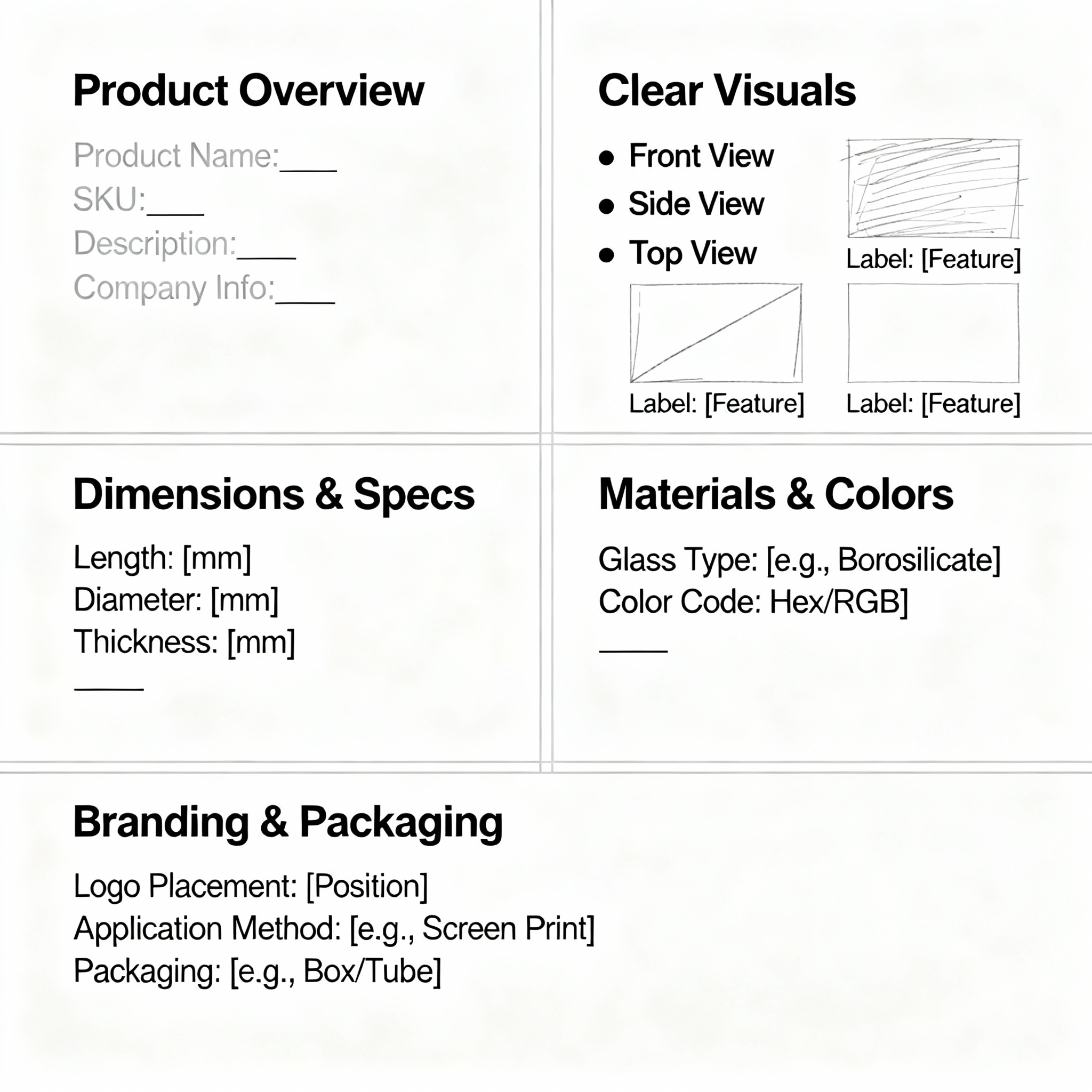
- Prepare a complete technical specification for your design, including dimensions, glass type, color, weight, and any branding elements. The more detailed your spec, the fewer revision rounds you will need.
- Request a written quote that itemizes the sample fee, mold cost (if applicable), shipping, and the credit or refund terms.
- Confirm the time window for claiming a credit and the minimum order threshold that triggers a refund.
- Ensure an NDA is signed before sharing your design files.
- Clarify who owns the mold and tooling after fabrication.
- Ask what happens if the sample does not match your specification. The answer should be a free remake.
- Confirm the sample lead time. For borosilicate glass pipes, a typical sampling window is 1 to 3 days for standard designs, with longer timelines for complex shapes or new mold fabrication.
If any of these points are unclear or the supplier resists putting them in writing, you have identified a risk before it becomes a cost. Addressing these questions early is always cheaper than resolving a dispute after the sample has shipped.
Wrapping Up: The Sample Fee as a Relationship Indicator
A sample fee is never just a fee. It is the first financial transaction between you and your supplier, and the way it is structured, communicated, and honored sets the tone for everything that follows. A fair, transparent sample fee policy signals a factory that respects your investment and understands the dynamics of a B2B partnership. A vague or shifting fee structure signals the opposite.
The three models, refundable deposit, credit on order, and sunk cost, each have their place. None of them is inherently better or worse. What matters is that you understand which model you are working with, that the terms are explicit, and that both parties know what happens when the sample leads to a production order.
If you are ready to discuss a custom glass pipe project and want to understand how sampling works with a manufacturer that prioritizes transparency at every stage, reach out to the Elfglass team directly. The conversation starts with your design, not with an invoice.
Frequently Asked Questions
Are samples ever free from glass pipe manufacturers?
Some suppliers offer free samples of existing catalog items as a goodwill gesture, particularly if you are evaluating a potential bulk order. However, custom samples that require new setups, custom colors, or new molds almost always carry a fee. The factory incurs real production costs for custom work, and a legitimate supplier will charge for that rather than hiding the cost in your production unit price.
Should sample fees be refundable?
Refundable sample fees are the most buyer-friendly model, but they are not the industry default. The credit-on-order model, where the sample fee is deducted from your production invoice, is more common in glass pipe OEM manufacturing. Whether a fee is refundable or credited, the important thing is that you recover the cost when you move to production. Always confirm the terms in writing before paying.
How much do custom glass pipe samples typically cost?
Sample costs vary widely depending on design complexity, whether a new mold is needed, and the supplier’s labor rates. Simple modifications to existing designs cost less. Completely new shapes with custom molds cost more. The key is not the absolute number but whether the fee is itemized, transparent, and credited against your production order. Request a detailed quote before committing.
What happens to the sample fee after I place a bulk order?
Under a credit model, the sample fee is applied as a deduction on your production invoice. Under a refundable deposit model, the fee is returned to you after the bulk order is confirmed. Under a sunk cost model, the fee is not recovered. The specific outcome depends on your supplier’s sample fee policy, so confirm the terms before paying.
Can I negotiate sample fees with a glass pipe supplier?
Yes. The most effective approach is to demonstrate production intent with concrete volume projections and timelines. You can also reduce per-sample costs by consolidating multiple designs into a single sampling session. Negotiating the credit terms, such as extending the time window or increasing the credit percentage, is often more productive than simply asking for a lower fee.
Do I own the mold used for my custom glass pipe sample?
In standard industry practice, yes. When you pay for a custom mold, it is your property. The factory stores it and uses it for your production runs, but they should not use it for other clients. This ownership should be stated explicitly in your supplier agreement or NDA before sampling begins.
About the Author
Ava Zeng is the founder of Elfglass, a Shenzhen-based borosilicate glass pipe manufacturer serving B2B brands worldwide. Every guide on this site is grounded in her production-floor experience— the annealing lines, QC checkpoints, and export orders behind each claim.
Before you commit to a supplier, read her founder’s story and trust promise, and the guide to vetting a reliable glass pipe manufacturer— the same red-flag checklist Elfglass applies to its own suppliers.
Sample-fee structures follow the conventions in sample marketing practices, where upfront costs signal buyer commitment and filter non-serious inquiries.
Ready to Source Custom Glass Pipes?
Get a free quote within 24 hours. MOQ from 100 pieces. NDA-protected design consultation.
