A glass pipe without branding is a commodity.
It’s just another tube on a shelf. But a pipe with a logo is an identity.
Choosing the right glass pipe branding techniques is one of the most critical decisions a founder makes.
When a customer picks up your product, that logo is often the first thing they touch.
If it peels off after three washes, your brand promise peels off with it. To narrow the field before you commit, our comparison of glass logo application methods walks through how printing, etching, and sandblasting each hold up over time.
According to a report by Forbes on the value of brand consistency, consistent brand presentation across all platforms increases revenue by up to 23%. Your email list is one of those platforms: the same logo and voice should meet customers in the inbox, a point our guide to
In the glass industry, this consistency starts with the hardware itself.
As Brand Architects at Elfglass, we don’t just manufacture glass; we safeguard identities.
We understand that choosing between a gold decal and a deep sandblast isn’t just an aesthetic choice—it’s a financial and strategic one.
That strategy starts with the name itself, before any logo technique is chosen. Our guide to naming your smoke shop brand walks through the five tests a name must pass, including trademark and private-label checks that keep it ownable.
This guide explores the 5 best glass pipe branding techniques available in OEM manufacturing, helping you decide which method creates the legacy your brand deserves.
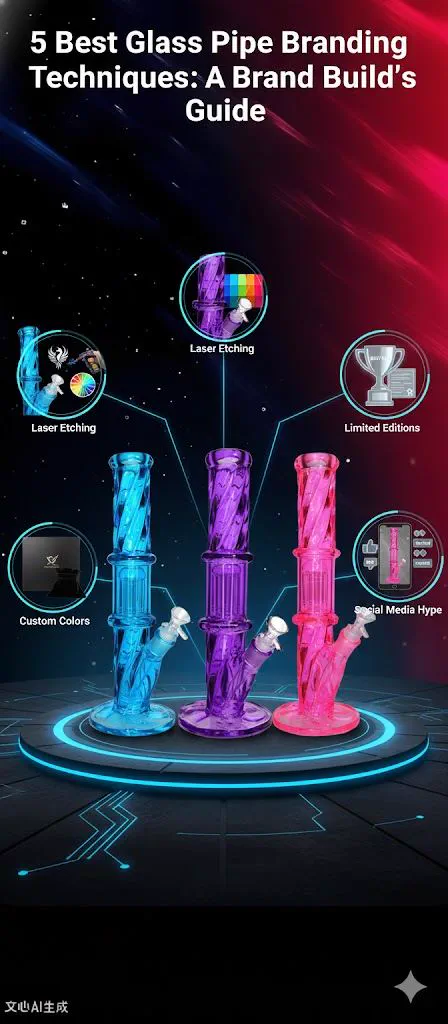
1. High-Temperature Decals: The King of Color
If your brand identity relies on specific Pantone colors or illustrative artwork, decals are often the most versatile of all glass pipe branding techniques.
But be warned: not all decals are created equal.
The Process: Fired, Not Stuck In the cheap souvenir market, factories use “cold application” stickers.
At Elfglass, we strictly use High-Temperature Kiln-Fired Decals.
-
We print your logo using ceramic inks containing ground glass (frit).
-
The piece is fired in a kiln at over 1050°F (565°C).
During this firing, the ceramic ink fuses into the surface.
When it cools, the logo is no longer on the glass; it is the glass.
“I can still vividly remember the disappointment I felt years ago buying a ‘branded’ mug, only to have the logo disappear into the dishwasher drain after a week.
That hollow feeling is exactly what I swore our clients would never experience.”
2. Sandblasting (Etching): The Touch of Luxury
If decals are “loud,” sandblasting is “quiet confidence.”
Among premium glass pipe branding techniques, this is the choice of the artisan.
The Process: Carving with Grit Sandblasting is aggressive. It is not printing.
It is carving.
A stream of abrasive grit tears into the surface to leave a mark that will outlast us all.
We apply a photosensitive film mask to the glass and blast it with aluminum oxide.
The result is a frosted, matte finish.
The “Feel” Factor The real value of sandblasting is physical.
When a customer holds a sandblasted bong, their thumb settles into the recession of the logo.
It feels like stone.
For high-end “scientific” glass brands, this matte finish signals precision.
3. Laser Etching: Speed and Precision
If sandblasting is the chisel, the laser is the scalpel.
It aligns perfectly with the modern need for speed.
UV vs. CO2: We strictly use UV Lasers for our glass pipe branding techniques.
Older CO2 lasers use heat, creating jagged micro-cracks.
UV lasers use “cold marking” to break molecular bonds without thermal shock, ensuring your bong doesn’t shatter spontaneously.
The QR Code Revolution Imagine etching a unique QR code on every bong.
When scanned, it takes the customer to a “Batch Report.”
This turns a static product into a digital portal.
4. Precious Metal Decals: The “Bling” Factor
For the boutique brand owner, ink isn’t enough. You need gold.
The Process: Alchemy We use Real 22k Gold or Platinum paste.
Because gold reflects light so brilliantly, even a small logo creates an immediate high-value perception.
This technique allows you to raise your retail price significantly.
Turn Your Concept Into Production-Ready Glass
Elfglass takes you from design brief and CAD/STEP files to prototyping, branding, and mold exclusivity, with your IP protected by NDA. Send us your concept and we will return a manufacturable plan and quote.
MOQ from 100 pieces | BSCI / WRAP / ISO 9001 | NDA before every project
5. Molded Logos: The Ultimate Commitment
For brands scaling to tens of thousands of units, applying decals by hand is a bottleneck.
The solution is to build the brand into the manufacturing process.
The Process: Embossed Glass We use CNC machines to carve your logo directly into the graphite mold.
As the molten borosilicate is blown into the mold, it expands into the crevices of your logo.
The result is a logo that is Embossed (raised) or Debossed (sunken).
How to Choose Between Glass Pipe Branding Techniques
Choosing a technique isn’t just about what you like; it’s about what your customer expects.
The Decision Matrix:
-
Playful/Loud Brand? Go with High-Temp Decals.
-
Scientific/Minimalist? Go with Deep Sandblasting.
-
High-Ticket Luxury? Go with Real Gold.
-
High Volume? Go with Molded Logos.
What Each Technique Requires: Files, MOQ, and Lead Time
The technique you choose changes what you send the factory. High-temperature decals need full-color print files with the artwork at production resolution; sandblasting needs a high-contrast design that reads at depth; laser etching needs clean vector paths that survive scaling. Whatever the method, the artwork must be final before sampling, because every revision after the first sample costs a round trip of 1-3 days on top of your timeline.
Send the artwork with a written brief so nothing is lost in translation between your brand team and the production line. The design brief guide covers the fields the factory actually needs: logo placement, size range, color references, and the surfaces the mark must survive.
From Logo File to Shipment: The Branded Order Workflow
A branded order runs a predictable sequence: artwork review, sample confirmation, batch production, and pre-shipment QC. Elfglass confirms pricing within 24 hours and returns samples in 1-3 days, so the first two steps fit inside a working week. The production step follows the standard commercial frame, a 100-unit MOQ with a 30% T/T deposit, and the shipment step is gated by the same inspections that apply to unbranded glass.
For the factory side of the decision, the factory audit checklist shows which documents and records prove the line can handle branding work, including annealing records and QC staffing, before you commit your logo to someone else’s kiln.
Branding Technique Comparison: Durability, Cost, and Best Use
The five techniques are described above one at a time; lined up in a single table, the choice becomes a match between your brand personality, your volume, and your budget. Every row restates a property already covered — the value is in comparing them directly rather than reading five separate sections.
| Technique | How It Is Applied | Durability | Relative Cost | Best For |
|---|---|---|---|---|
| High-temperature decals | Ceramic frit ink kiln-fired over 1050°F (565°C) until it fuses into the surface | Permanent — the logo becomes the glass | Moderate | Full-color Pantone and illustrative art; playful, loud brands |
| Sandblasting (etching) | Photosensitive mask, then aluminum-oxide grit carves a frosted recess | Permanent — carved, not printed | Moderate–high | Scientific / minimalist premium; tactile “feel” brands |
| Laser etching (UV) | Cold marking breaks molecular bonds with no thermal shock | Permanent | Low–moderate, fast | Fine detail, QR codes, speed and precision |
| Precious metal decals | Real 22k gold or platinum paste fired onto the surface | Permanent | High | Boutique luxury; high-value perception that lifts retail price |
| Molded logos | CNC-carved into the graphite mold; glass expands into it (embossed or debossed) | Permanent — in the glass body | Tooling upfront, lowest per-unit at scale | High volume (tens of thousands of units) |
Logo Artwork Prep: File Requirements by Technique
The most common cause of a delayed branded order is artwork sent in the wrong format — the factory cannot proceed, and every revision after the first sample adds a 1–3 day round trip. Prepare the file to the technique you chose, and make it final before sampling.
- High-temperature decals. Send full-color artwork at production resolution with Pantone references. CMYK gradients are reproducible, so illustrative and multi-color logos work here.
- Sandblasting. Send a high-contrast, single-color design that reads at depth. Thin lines and fine detail lose definition when carved, so favor bold shapes over intricate ones.
- Laser etching. Send clean vector paths, not raster images — vectors survive scaling and keep the cold-mark crisp. QR codes must be vector with an adequate quiet-zone margin so they still scan.
- Precious metal decals. Simplify the artwork. Gold and platinum paste cannot hold hairline detail, so reduce the mark to strong, legible shapes.
- Molded logos. Send the logo as a toolpath-ready vector and specify embossed (raised) or debossed (sunken), plus the minimum line width and depth the graphite mold can hold.
- For every technique. Send the artwork with a written brief — logo placement, size range, color references, and the surfaces the mark must survive — so nothing is lost between your brand team and the production line.
Conclusion: Make it Permanent
Your brand is your legacy.
It represents the sleepless nights and the promise you make to your customers.
Don’t let that legacy be a sticker that peels off.
Whether you choose sandblasting or gold decals, Elfglass ensures your mark is durable.
By understanding these glass pipe branding techniques, you can make a choice that lasts.
Ready to leave a permanent mark? [Send us your logo file] for a free branding consultation.
Frequently Asked Questions (FAQ)
Q1: Will water transfer decals peel off?
A1: Not ours. We use High-Temperature Baking decals fired at over 560°C, fusing the ink into the glass surface for permanent adhesion.
Q2: Can you achieve gradient colors?
A2: Yes. High-Temp Decals allow for full CMYK color ranges, unlike sandblasting which is monochrome.
Q3: What is the most premium option?
A3: Deep Sandblasting or Real Gold Decals. Both offer undeniable visual and tactile value.
(For more on matching your design to your manufacturing method, read our guide on Building a Product Catalog or explore Custom Glass Molds.)
Building your wholesale lineup? Explore our custom-branded hand pipes and water pipes for MOQ, tiered pricing, and factory-direct lead times. Send us your product spec and target quantity — contact our factory team or message us on WhatsApp, and we will reply with pricing and lead times within 24 hours.
To see how logo application fits into a complete order, follow our step-by-step custom process from design file to branded finished goods.
About the Author
Ava Zeng is the founder of Elfglass, a Shenzhen-based borosilicate glass pipe manufacturer serving B2B brands worldwide. Every guide on this site is grounded in her production-floor experience— the annealing lines, QC checkpoints, and export orders behind each claim.
For the two permanent marking methods in detail, our laser engraving versus sandblasting comparison explains which suits fine detail versus bold, tactile logos.
Before you commit to a supplier, read her founder’s story and trust promise, and the guide to vetting a reliable glass pipe manufacturer— the same red-flag checklist Elfglass applies to its own suppliers.
Ready to Source Custom Glass Pipes?
Get a free quote within 24 hours. MOQ from 100 pieces. NDA-protected design consultation.
