

A clear spoon pipe leaves the factory at $3.20 and sits on a smoke shop shelf at $19.99. Somewhere between those two numbers is a freight bill, a customs entry, a package, a wholesaler, and a retailer — each taking a cut. Most buyers who underprice their glass never lost the margin on the factory quote. They lost it because they ran the markup on the wrong number, or confused markup with margin and celebrated a profit that was not there.
This is a working calculator, not a lecture. We build the denominator first — real landed cost — then apply markup and margin formulas you can run on any SKU, and finish with a full 500-piece example. Elfglass, the factory behind this site, quotes FOB every day; the buyers who stay profitable are the ones who know exactly what happens to that number after it leaves our dock.
Glass pipe markup = (selling price − landed cost) ÷ landed cost × 100. To set a price from a target markup, multiply landed cost by (1 + markup). Use landed cost — FOB plus freight, duty, packaging, and amortized sampling — not the factory price alone, and remember a 100% markup equals a 50% margin.
Key Takeaways
- Markup is measured on cost; margin is measured on price. A 100% markup = a 50% margin.
- Always mark up landed cost, never the FOB quote — freight, duty, and packaging are real costs.
- Price = cost × (1 + markup). Cost = price ÷ (1 + markup). Learn both directions.
- Wholesale and retail are two markups on the same unit; work backward from MSRP.
- Every dollar figure here is illustrative — plug in your own landed cost before you quote.
Table of Contents
Markup vs Margin: The Distinction That Costs Money
Two numbers describe the same profit and they are not interchangeable. Markup is profit divided by cost. Margin (gross margin) is profit divided by the selling price. Because the denominator differs, the same deal shows a bigger percentage under markup — and that is exactly where buyers fool themselves.
Take a pipe you land at $6 and sell for $12. The profit is $6 either way. Markup reads $6 / $6 = 100%. Margin reads $6 / $12 = 50%. Someone who says “I mark everything up 50%” and someone who says “I keep a 50% margin” are describing completely different prices. Per the standard business definition of markup, the base is always cost; the base for margin is always revenue.
| You say | Formula | On a $6 cost | Resulting price |
|---|---|---|---|
| 100% markup | cost × 2 | $6 × 2 | $12 (50% margin) |
| 50% markup | cost × 1.5 | $6 × 1.5 | $9 (33% margin) |
| 50% margin | cost ÷ 0.5 | $6 ÷ 0.5 | $12 (100% markup) |
| 33% margin | cost ÷ 0.67 | $6 ÷ 0.67 | $9 (50% markup) |
Read that table twice, because the third and fourth rows are the trap. A “50% margin” target produces a much higher price than a “50% markup” — $12 versus $9. If you set prices by margin but quote by markup, you will systematically undercharge. Pick one convention for your whole business and write it on the pricing sheet.
The Markup Formula, Both Directions
A calculator only helps if you can run it forward and backward. Forward, you know cost and want price. Backward, you know a target retail price and want to check the cost ceiling you can afford. Both are one line each.
| Direction | You know | Formula | Example |
|---|---|---|---|
| Price from markup | cost, markup% | price = cost × (1 + markup%) | $6 × (1 + 1.00) = $12 |
| Markup from price | cost, price | markup% = (price − cost) ÷ cost | ($12 − $6) ÷ $6 = 100% |
| Margin from price | cost, price | margin% = (price − cost) ÷ price | ($12 − $6) ÷ $12 = 50% |
| Cost ceiling | price, markup% | cost = price ÷ (1 + markup%) | $12 ÷ 2 = $6 |
| Convert | markup% | margin% = markup ÷ (1 + markup) | 1.00 ÷ 2 = 50% |
Keep a conversion strip handy so you never mix the two conventions again. Corporate Finance Institute publishes the same markup-to-margin relationship; the ratios below are pure arithmetic and hold for any product.
| Markup % | Margin % | Markup % | Margin % |
|---|---|---|---|
| 50% | 33.3% | 200% | 66.7% |
| 75% | 42.9% | 300% | 75.0% |
| 100% (keystone) | 50.0% | 400% | 80.0% |
Need a Clean FOB Number to Mark Up?
Every calculation on this page starts with an honest factory price. Send your design and quantity and get an itemized quote within 12 hours — so your landed-cost stack has a real denominator instead of a guess.
MOQ from 100 pieces | Quotes in 12 hours | Itemized FOB pricing
Build Your Landed Cost First
Here is where underpriced glass actually dies. The factory quote is the smallest line in your cost stack, not the whole stack. Mark up the FOB number and you are calculating profit on a figure that ignores everything it cost to get the piece onto your shelf. Build landed cost per unit first, then apply markup to that.

Landed cost per unit = FOB unit price + allocated freight + import duty + packaging + amortized sampling. Each piece has a home:
| Cost layer | How to allocate per unit | Watch for |
|---|---|---|
| FOB unit price | Straight from the quote | Whether tooling is billed separately |
| Freight (sea/air) | Total freight ÷ units in shipment | Dimensional weight on bulky pieces |
| Import duty | Duty ÷ units; see the duties guide | Duty on CIF value, not FOB |
| Packaging | Per-unit box, foam, insert cost | Retail-ready packs cost more |
| Sampling / molds | One-time fee ÷ planned units | Amortize over the run, not order one |
Duty deserves its own pass because it compounds: it is usually assessed on the CIF value (goods plus freight plus insurance), not the FOB price, so a cheap freight quote can still raise your duty base. Our import duties by country guide walks the calculation with US and UK worked examples, and cost of importing from China shows the full landed-cost stack in one place. Amortize tooling the same way — the tooling amortization guide explains spreading a mold fee across the run instead of loading it onto the first order.
Warning: a $3.20 FOB pipe with $0.55 freight, $0.35 duty, $0.40 packaging, and $0.30 amortized sampling lands at $4.80 — a real cost 50% higher than the quote. Mark that pipe up 100% on FOB ($6.40) instead of on landed ($9.60) and you gave away $3.20 a unit without noticing.
Worked Example: A 500-Piece Order Priced to Retail
Now run the whole machine on one SKU. All figures are illustrative — swap in your own quote, freight, and duty. A brand orders 500 clear spoon pipes, custom logo, retail-ready packaging.
| Line | Amount | Per unit (÷500) |
|---|---|---|
| FOB goods (500 × $3.20) | $1,600 | $3.20 |
| Sampling fee (one-time) | $150 | $0.30 |
| Retail packaging | $200 | $0.40 |
| Sea freight (allocated) | $275 | $0.55 |
| Import duty (on CIF) | $175 | $0.35 |
| Landed cost | $2,400 | $4.80 |
From a $4.80 landed cost, the price you set depends entirely on the channel you sell through. This is the part most first-time importers miss: wholesale and retail are two separate markups stacked on the same physical unit.
| Channel | Your price | Your markup | Your margin | Typical MSRP |
|---|---|---|---|---|
| Sell DTC online | $19.20 | 300% | 75% | $19.20 |
| Sell wholesale (keystone) | $9.60 | 100% | 50% | $19.20 |
| Sell to a distributor | $7.20 | 50% | 33% | $19.20 |
Read the middle row carefully. If you sell wholesale at $9.60 and the shop keystones it, the consumer pays $19.20 — the same MSRP you would charge selling direct. The shop earned its 50% for holding inventory and foot traffic; you gave up margin for volume and reach. Neither channel is wrong, but you must decide which one you are pricing for before you quote, because the wholesale number is half the direct number.

The verdict for a new brand: model DTC and wholesale separately, then check that both clear your costs at realistic volumes. Our glass pipe brand startup cost guide shows how a 500-piece order fits into a total first-year budget, so the markup feeds a real cash plan instead of a spreadsheet fantasy.
Typical Retail Multiples for Glass
What multiples does the market actually bear? Use ranges as a sanity check, never as a target you copy blindly. Keystone — a 100% markup, 50% margin — is the classic retail baseline, and functional glass usually prices at or above it because breakage, display, and slow-moving designs eat into shop margin. Small accessories and impulse items often carry higher multiples; large heady pieces carry lower ones because the absolute dollar profit is already big.
| Product tier | Common retail markup | Margin range | Why |
|---|---|---|---|
| Small accessories | 200-400% | 67-80% | Low ticket, impulse buy |
| Production hand pipes | 100-200% | 50-67% | Keystone baseline |
| Mid water pipes | 75-150% | 43-60% | Higher ticket, more shelf risk |
| Heady / limited | 40-100% | 29-50% | Big absolute profit per unit |
These bands are planning ranges, not quotes — your market, brand, and sell-through decide where in the band you land. For a data-informed view of what shops actually charge, see our breakdown of wholesale glass margins and retail markups, and for higher-ticket pieces the dab rig pricing strategy guide, where margins run richer than on bongs.
Pricing Beyond a Flat Markup
A single flat markup across every SKU and every customer is the simplest system and usually the least profitable. Three adjustments turn a calculator into a pricing strategy.
First, tier by volume. A shop buying 12 units and a chain buying 1,200 should not pay the same wholesale price; structured dealer tiers protect your margin at the small end while rewarding scale. Our wholesale pricing tiers guide shows how to build the ladder so discounts come from volume, not negotiation pressure.
Second, protect the number with a MAP policy. If your wholesale customers race to the bottom online, your brand and your margin both erode. A minimum advertised price keeps retail prices stable across channels; our MAP policies guide covers how brands enforce it without angering good shops.
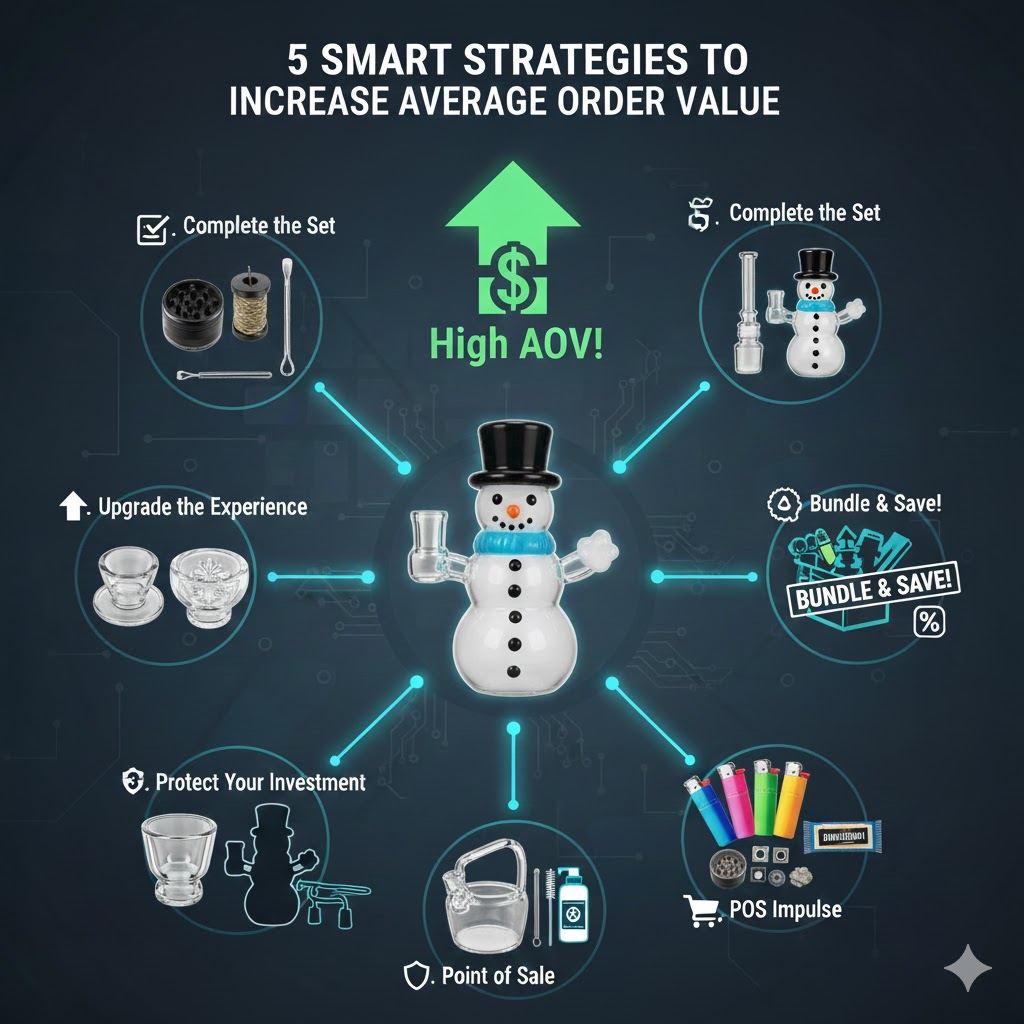
Third, lift average order value instead of cutting price. Bundles, assortments, and add-on accessories raise revenue per transaction far more safely than shaving markup on a single SKU — the same pipe at keystone inside a $60 starter bundle outsells it at a discount alone.
Four Markup Mistakes That Eat Margin
The math is easy; the discipline is not. These four errors show up on almost every underpriced order we see.
- Marking up FOB instead of landed cost. The single most expensive habit. Freight, duty, and packaging are not overhead — they are cost of goods. Add them before the multiplier.
- Confusing markup with margin. Saying “50%” without naming the base. A 50% margin needs a 100% markup. Write the convention on the sheet.
- Forgetting the second markup. Wholesale price and MSRP are different numbers on the same unit. If the shop keystones, your wholesale is half the shelf price — plan both.
- Amortizing sampling over one order. Loading a $150 sample fee onto 100 units adds $1.50 each; spread across the year’s planned volume it is cents. Match the amortization to the real run.
One more, quieter mistake: copying a rival brand’s retail price and back-solving a cost you cannot actually hit. Price from your own landed cost outward. If the market will not bear the number your costs require, the fix is a cheaper supply chain or a different product — not a thinner margin you pretend is fine.
Conclusion
A markup calculator is only as good as the cost you feed it. Build landed cost first — FOB plus freight, duty, packaging, and amortized sampling — then apply the markup, and keep markup and margin straight so you never celebrate a phantom profit. Price wholesale and retail as two markups on one unit, and work backward from the MSRP you want on the shelf.
Your formula quick-reference card:
- Landed cost = FOB + freight + duty + packaging + (sampling ÷ units)
- Price from markup = landed cost × (1 + markup%)
- Markup % = (price − landed cost) ÷ landed cost × 100
- Margin % = (price − landed cost) ÷ price × 100
- Convert: margin = markup ÷ (1 + markup); 100% markup = 50% margin
- Wholesale check: if the shop keystones, wholesale = MSRP ÷ 2
Run your own numbers before the next order. Request an itemized quote and you will get a real FOB figure to feed the calculator — the honest denominator every profitable price starts from.
What is the formula to calculate markup on a glass pipe?
Markup percentage = (selling price – cost) / cost, times 100. To set a price from a target markup, multiply cost by (1 + markup). The cost you use should be landed cost, not the factory FOB price.
What is the difference between markup and margin?
Markup is measured against cost; margin is measured against the selling price. A 100 percent markup equals a 50 percent margin. Confusing the two makes a price look healthier than it is.
What markup do smoke shops typically put on glass pipes?
Retail glass often runs between keystone (100 percent markup, 50 percent margin) and 300 percent markup on small accessories. Treat any specific figure as a planning range, not a rule.
Should I mark up the FOB price or the landed cost?
Always landed cost — FOB plus freight, duty, packaging, and amortized sampling. Marking up FOB hides the imported costs and quietly erodes your real margin.
How do I price for wholesale and retail at the same time?
Work backward from MSRP. If a shop keystones your wholesale price, your wholesale must be half the intended retail. Set both numbers before you quote, not after.
Ready to Start Your Custom Glass Pipe Project?
Get a free quote within 24 hours. MOQ from 100 pieces. NDA-protected design consultation.
