
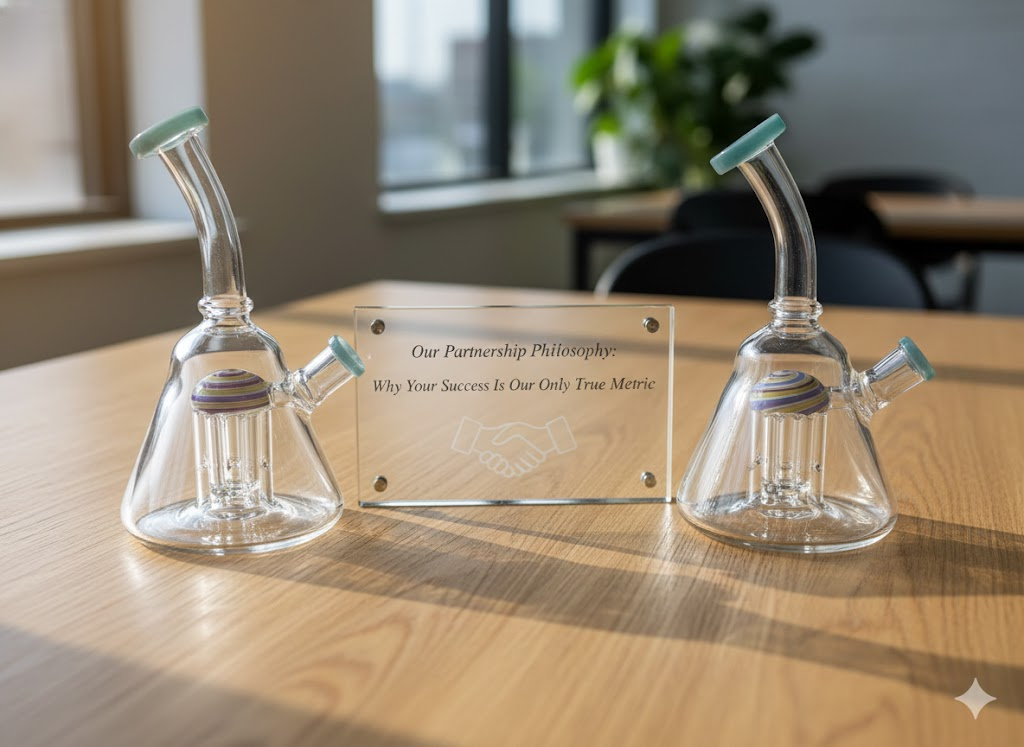
The most overlooked revenue lever in the glass pipe industry is not the pipe itself. It is the box the pipe ships in. A retailer who receives 100 identical brown cartons from a factory, slaps a sticker on each one, and puts them on a shelf has built a commodity business. The brands commanding premium retail prices and earning repeat orders from distributors are the ones whose packaging communicates brand identity before the customer ever sees the product inside. Packaging design balances protection, compliance, and brand communication—a discipline with its own engineering standards (packaging and labeling reference).
Custom packaging design for glass brands is not decoration—it is a commercial decision that affects shelf conversion, damage rates, unboxing experience, and whether a retailer reorders from you or from the next factory on the list. This guide covers the packaging decisions that matter for B2B glass brands: material selection, structural design, print methods, regulatory compliance, and how to integrate packaging into your OEM production workflow.
Related reading: metal accent pricing.
Key Takeaways
- Custom packaging increases retail shelf conversion by creating brand recognition before the customer reads any product description.
- Structural design determines damage rate: a well-designed insert reduces transit breakage more than any external carton upgrade.
- Offset printing suits runs of 500+ units; digital printing serves MOQ-100 trial orders without plate costs.
- Elfglass integrates packaging into the same 7–12 day production window as the glass product, with sampling in 1–3 days.
- Regulatory text requirements (age warnings, material disclosures) vary by destination market and must appear on the final artwork before print approval.
Why Packaging Is Your Brand’s First Impression
A smoke shop shelf holds dozens of glass pipes from different factories. Most arrive in identical kraft boxes with a printed label. The retailer stocks them side by side, and the customer chooses based on price because nothing else differentiates the products visually. This is the commodity trap.
Custom packaging breaks the trap at the point of first contact. A box with your brand colors, logo treatment, and structural uniqueness creates recognition before the customer picks up the pipe. Retailers notice too: a brand that invests in packaging signals that it will invest in marketing, trade support, and reorder reliability. Distributors choosing between two factories with similar product quality consistently pick the one whose packaging makes their shelf look better.
The commercial math is straightforward. If custom packaging adds a small per-unit cost but increases shelf-to-sale conversion enough to generate reorders, the packaging pays for itself within the first production cycle. Brands that skip packaging to save per-unit cost often spend more later on discounting slow inventory that failed to differentiate.
Related reading: custom manufacturing constraints.
Structural Design: Protecting Glass in Transit
Glass breaks. The packaging’s primary engineering job is ensuring the product survives factory-to-retailer transit without damage. Structural design matters more than surface graphics for this purpose.
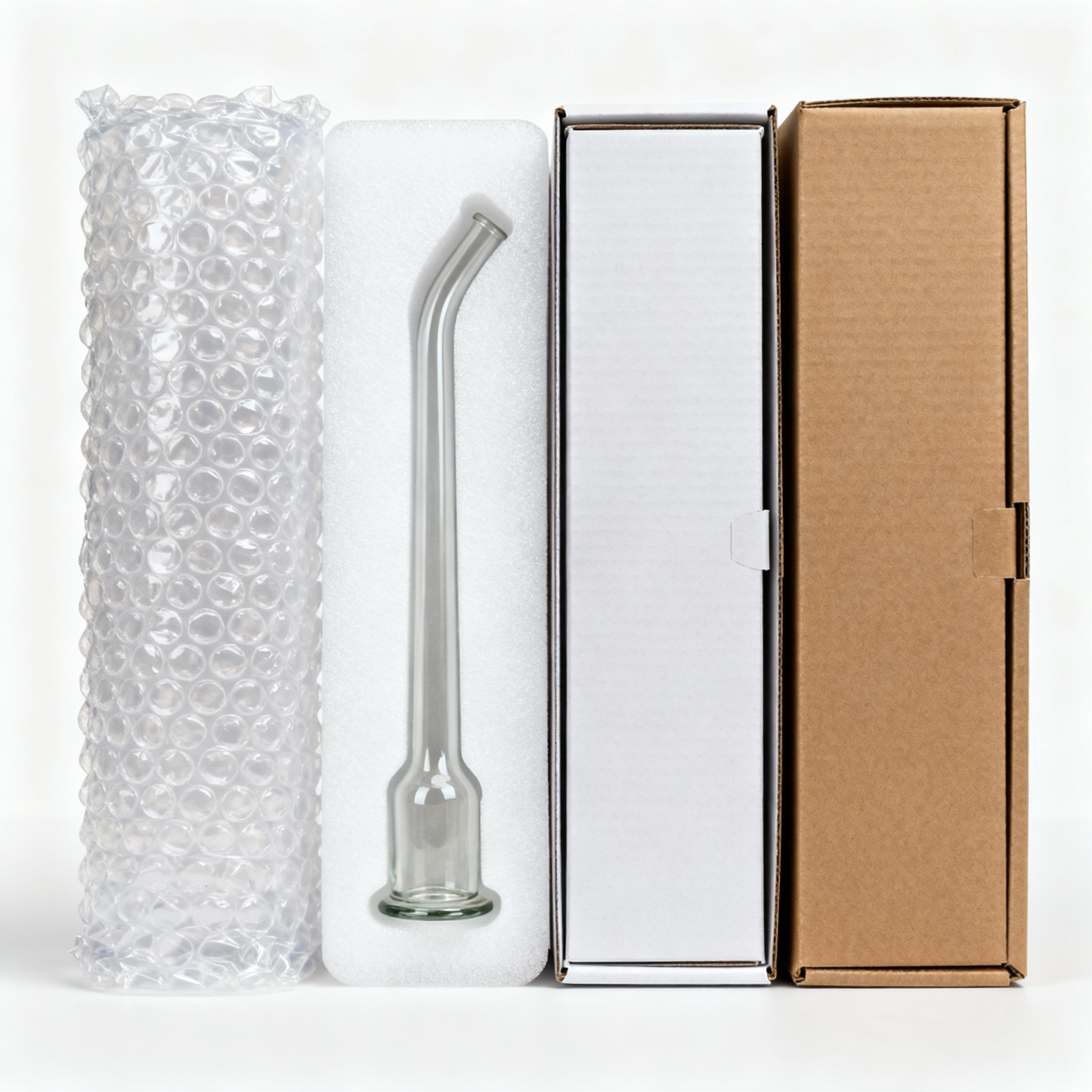
The insert is the critical component. A molded pulp or die-cut foam insert cradles the pipe at its strongest points (base and mouthpiece) while suspending fragile elements (joint, percolator arms, bowl) away from carton walls. Generic inserts that came with the factory’s standard box rarely match your specific product geometry. Custom inserts, designed from your product’s exact dimensions, reduce damage claims dramatically.
Three structural rules from production experience: first, the pipe should not move when the closed box is shaken gently—any movement means the insert is undersized. Second, no glass surface should contact the carton wall directly; foam or pulp must intervene at every potential contact point. Third, the box should survive a 60cm drop test onto its corner without transferring force to the product inside. Factories running ISO 9001 quality systems include drop testing in their packaging QC, but buyers should specify this requirement explicitly in the purchase order.
Material Selection by Price Tier
Packaging material communicates price positioning before the customer reads any text. Match the material to your retail tier.
Entry-level (budget retail): Single-wall kraft cardboard with one-color flexographic print. Lowest cost, recyclable, functional. Suits high-volume SKUs where the pipe itself carries the value proposition.
Mid-range: White-coated cardboard (SBS or CCNB) with offset printing in 2–4 colors. Allows full-color brand graphics, product photography, and regulatory text. This is the volume sweet spot for brands building retail recognition.
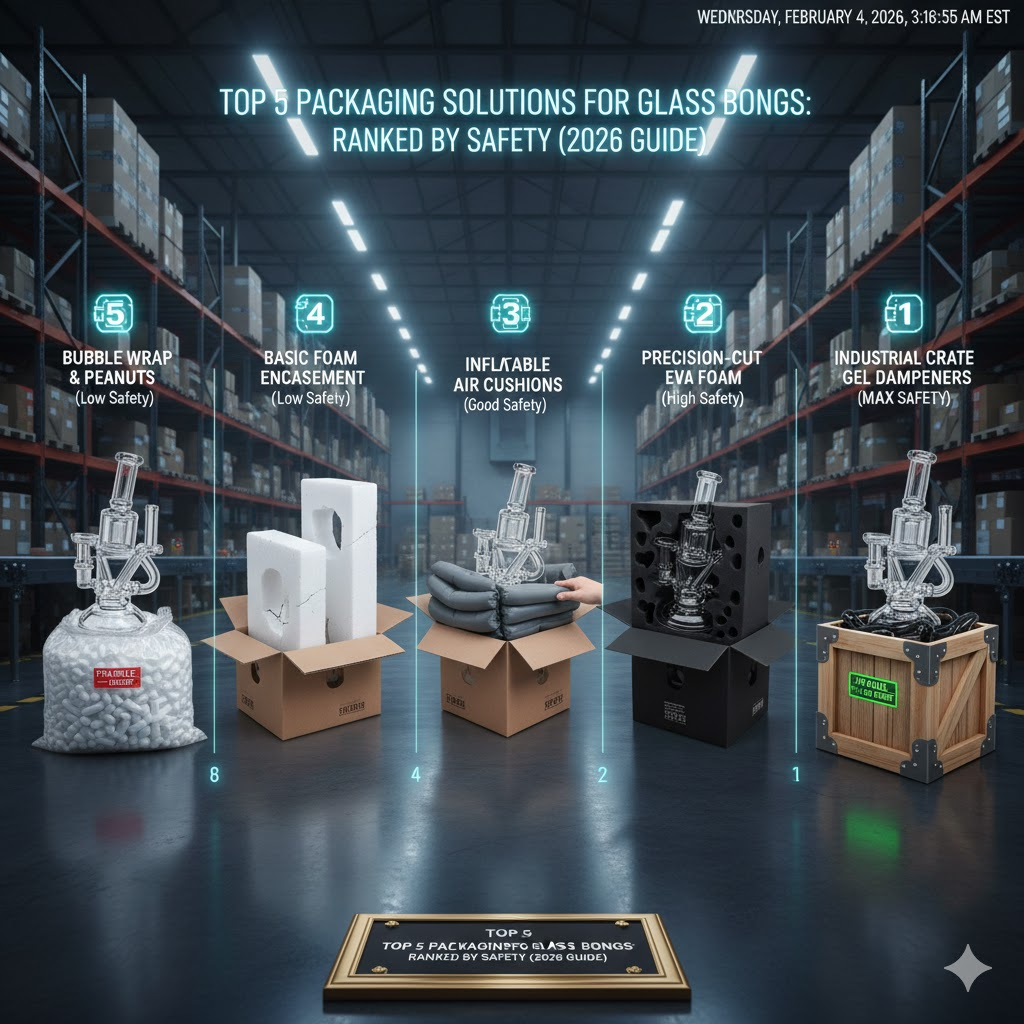
Premium (collector and boutique retail): Rigid setup boxes with magnetic closure, soft-touch lamination, or foil stamping. Per-unit cost rises significantly, but the unboxing experience justifies premium retail pricing. Reserve this tier for limited editions or flagship products where the packaging itself becomes part of the brand story.
One material decision that affects both cost and brand perception: window cutouts. A clear PET window lets customers see the product without opening the box, which reduces handling damage in retail. But it adds material cost and complicates recycling. For mid-range brands, a small window showing the pipe’s color and shape delivers most of the visual benefit at moderate cost.
Print Methods and Minimum Runs
The print method you choose depends on order volume and color complexity. Choosing wrong means either overpaying for plates you will never amortize, or accepting quality limitations that undermine your brand.
Offset lithography: Best quality for full-color graphics, photographic reproduction, and fine text. Requires metal plates, so setup cost is fixed regardless of quantity. Economical at 500+ units per design; per-unit cost drops sharply as volume increases. Standard for mid-range and premium packaging.
Flexography: Suited to 1–2 color designs on kraft or uncoated stock. Lower setup cost than offset, faster turnaround. Works well for entry-level packaging where brand colors are simple and text dominates over imagery.
Digital printing: No plates required, so viable at 100-unit MOQ. Per-unit cost is higher than offset at volume, but total spend at low quantities is lower because there is no plate investment. Ideal for trial orders where you are testing packaging design alongside a new product. When choosing between OEM and ODM models, digital printing gives you design flexibility without committing to plate costs before validating the market.
Finishing processes: Matte/gloss lamination, spot UV, foil stamping, and embossing are applied post-print. Each adds cost and lead time. For a first custom packaging order, choose one finishing process maximum—test the market response before stacking multiple premium finishes.
Packaging and Freight Planned Around Your Route
From foam-insert and double-wall cartons to air or sea freight with clear Incoterms, we engineer packaging to cut breakage and quote landed cost honestly. Send us your destination and volume for a packing plan.
MOQ from 100 pieces | BSCI / WRAP / ISO 9001 | NDA before every project
Regulatory Text and Compliance
Glass pipe packaging carries regulatory text requirements that vary by destination market. Omitting required text can result in customs holds, retail fines, or marketplace listing removal.
Common requirements across major markets include: age restriction statements (18+ or 21+ depending on jurisdiction), product material identification, manufacturer or importer name and address, and country of origin marking. Some US states and Australian territories impose additional wording for tobacco-related accessories. The UK requires specific labeling under consumer product safety regulations.
The practical rule: finalize all regulatory text in your artwork file before sending to print. Adding text after plates are made requires new plates and restarts the production clock. Elfglass packaging workflow includes a compliance review step where destination-market requirements are checked against the artwork before print approval. Buyers should provide their destination country and retail channel (physical store, online marketplace, distributor) so the factory can flag jurisdiction-specific requirements.
From product spec to branded box: Elfglass handles glass production and custom packaging in one coordinated order, so your launch timeline stays intact.
MOQ 100 per design | BSCI & WRAP certified | See our OEM process
Integrating Packaging Into OEM Production
Packaging should not be an afterthought ordered separately from a print shop. When packaging and product production run on separate timelines, one inevitably delays the other, and your launch date slips.
At Elfglass, packaging design and production integrate into the same OEM workflow as the glass product. The sequence: product spec confirmed → packaging structural design created from product dimensions → artwork submitted by buyer → compliance review → print approval → packaging production runs parallel to glass production → final assembly packs finished pipes into branded boxes at the factory. Total timeline for a 100-unit order with custom packaging: sampling in 1–3 days for the glass product, packaging artwork approval running concurrently, bulk production 7–12 days.
This integration means your goods leave the factory in retail-ready packaging. No repacking at a third-party warehouse, no double-handling damage, no delay between product completion and branded presentation. For brands launching in a new market, factory-finished packaging means the first carton arriving at the distributor is the same quality as the thousandth.
Buyers who already have brand identity elements like logos and color systems should send vector files (AI or EPS format) and Pantone references. Raster images (JPEG, PNG) reproduce poorly on packaging print and limit finishing options.
Cost Structure and Budget Planning
Packaging cost scales with material tier, print complexity, and volume. Understanding the cost structure helps you allocate budget where it generates the most brand impact.
At MOQ-100 volumes, digital printing on coated cardboard with one finishing process is the most cost-effective entry point. Per-unit packaging cost at this volume will be higher than at 500+ units, but total capital exposure stays manageable while you validate the design with real retail feedback.
At 500+ units, offset printing amortizes plate costs and per-unit packaging cost drops substantially. This is where brands with proven sell-through should migrate for margin improvement. The transition from digital to offset is seamless if your artwork was created in vector format from the start—no redesign needed, just a different print process.
Budget allocation guidance for a first custom packaging order: allocate roughly 60% of packaging budget to structural design and insert engineering (protection), 30% to surface graphics and print (branding), and 10% to finishing (perceived premium). Brands that reverse this ratio—spending on foil stamping before solving insert geometry—end up with beautiful boxes full of broken glass.
Artwork Approval Workflow
The artwork approval stage is where most packaging delays occur. A structured workflow prevents the back-and-forth that adds weeks to your timeline.
Step one: submit your design brief with logo files, brand colors (Pantone codes), regulatory text, and any imagery. Step two: the factory returns a structural dieline template showing exactly where each panel, fold, and cut falls. Step three: your designer places artwork on the dieline and returns the print-ready file. Step four: factory compliance review checks regulatory text and print feasibility. Step five: you approve a digital proof or physical sample before bulk print begins.
The critical discipline: approve the physical sample before authorizing bulk print. Colors shift between screen and press. Text that reads well on-screen may be too small on the actual box. A physical proof in hand takes 24 hours to evaluate and prevents a 500-unit reprint. Elfglass provides physical packaging samples alongside product samples during the 1–3 day sampling window.
One risk to flag: if your brand operates in multiple markets with different regulatory requirements, do not attempt a single universal artwork. The compliance text for Australia differs from the US, which differs from the UK. Separate SKUs per market cost more in plates but eliminate the risk of a customs hold that freezes your entire shipment. Discuss destination-specific variants with your factory at the briefing stage, not after artwork is finalized.
Conclusion
Custom packaging transforms a factory product into a retail brand. The investment is modest at MOQ-100 volumes and returns compound through shelf recognition, reduced damage claims, and distributor confidence in your brand’s professionalism.
- Invest in structural insert design before surface graphics—protection drives fewer damage claims than aesthetics drive sales.
- Use digital printing for MOQ-100 trial packaging; migrate to offset at 500+ units for cost efficiency.
- Finalize regulatory text before print approval; post-plate changes restart production timelines.
- Integrate packaging into your OEM production window so goods leave the factory retail-ready.
Risk note: the most common packaging failure is not ugly design—it is approving artwork without a physical proof. Screen-to-press color shift and text size misjudgment cause more reprints than any other error. Always hold the sample before authorizing the full run. Start your packaging brief with Elfglass and receive structural recommendations within 12 hours.
Pair your packaging with our wholesale glass pipe lineup — packaging and product ship from the same OEM production window.
Frequently Asked Questions
What is the minimum order quantity for custom packaging?
At Elfglass, custom packaging runs at the same MOQ as the glass product: 100 units per design. Digital printing makes this volume economical without plate setup costs.
How long does custom packaging production take?
Packaging production runs parallel to glass production within the same 7 to 12 day window. Sampling completes in 1 to 3 days, including physical packaging proofs.
What print method should I choose for packaging?
Digital printing suits 100-unit trial orders with no plate costs. Offset lithography becomes economical at 500 plus units for full-color designs. Flexography works for 1 to 2 color kraft designs.
Do I need regulatory text on glass pipe packaging?
Yes. Age restrictions, material identification, importer details, and country of origin are common requirements. Specific text varies by destination market—finalize it before print approval to avoid costly plate changes.
Can packaging and product production happen simultaneously?
Yes. At Elfglass, packaging and glass production run on the same timeline. Finished pipes are packed into branded boxes at the factory, so goods arrive retail-ready.
About the Author
Ava Zeng is the founder of Elfglass, a Shenzhen-based borosilicate glass pipe manufacturer serving B2B brands worldwide. Every guide on this site is grounded in her production-floor experience— the annealing lines, QC checkpoints, and export orders behind each claim.
Before you commit to a supplier, read her founder’s story and trust promise, and the guide to vetting a reliable glass pipe manufacturer— the same red-flag checklist Elfglass applies to its own suppliers.
Packaging identity follows brand management principles, where visual consistency across touchpoints builds recognition and trust.
Ready to Source Custom Glass Pipes?
Get a free quote within 24 hours. MOQ from 100 pieces. NDA-protected design consultation.
