

The reorder supplier checklist below exists for one uncomfortable reason. Your second batch carries more risk than your first, not less. A trial order gets a factory’s sharpest attention and strictest inspection. A repeat order gets whatever room is left in the schedule.
Nobody decides to shortchange you. The pressure is structural: margin on a known buyer is easier to shave than margin on a new one. Small changes arrive singly — a different glass lot, a thinner wall, a cheaper inner box. Each looks harmless in isolation. Together they become the shipment your customers return.
Sixteen years of filling repeat orders taught the Elfglass team that the reorder moment deserves more scrutiny than the first order, not less. Reordering from a supplier is a fresh purchase, not an echo. The 15 checks below run in four phases: before the PO, during production, before shipment, and across your documentation.
Key Takeaways
- Run all 15 checks on every reorder. Repeat batches can drift from the approved spec, and the drift is silent by design.
- Lock the reference before money moves: countersigned spec sheet, labeled approved sample, price validity restated in writing. One hour of paperwork protects the whole batch.
- Elfglass answers quotes within 12 hours and signs NDAs before projects start. Treat that as the floor for any supplier you reorder from.
- Agree inspection sampling before production, not at shipment. ISO 2859-1 ties sample size to lot size, so both sides share the rules in advance.
- Never release the 70% balance before a pre-shipment inspection. Under Elfglass T/T terms — 30% deposit, 70% before shipment — that payment is your last checkpoint.
- Production for 100+ pieces runs 7 to 12 days at Elfglass. A lead time that stretches between orders is a warning signal, not weather.
Why the Second Batch Is Riskier
First orders are auditions. The factory assigns its most experienced hands, checks dimensions twice, and packs carefully, because winning the account depends on it. Reorders feel already won. That feeling is where discipline leaks out.
Drift rarely arrives as a decision. It arrives as turnover: a new pair of hands on the pipe, a grinding wheel one grade coarser, a furnace running hotter after service. No single change looks like a defect. Batch three simply stops matching the sample your brand approved.
Here is the part many buyers miss. Every supplier relationship carries this risk, including relationships with disciplined factories like Elfglass. The difference is what you get to hold onto: countersigned specs, first-piece approvals, inspection before balance. A weak supplier offers reassurance; a strong one offers evidence. Pick evidence, every time.
Five Reorder Checks Before Your PO
These five checks take about an hour and cost nothing. They shape everything downstream, because a mistake in the PO multiplies through production. That is why the strongest glass supplier reorder checks live before the deposit, not after.
Check 1: Re-Lock the Approved Sample Spec
Verdict: Non-negotiable. No PO until the spec is countersigned.
Confirm, in writing, that batch two gets built to the exact sample you approved. Pull the physical sample, the spec sheet, and the drawing file. Photograph the sample beside a dated note, label it with the PO number, and have both sides initial the spec.
A locked reference is the only defense against silent spec drift. Left alone, “same as last time” means whatever the factory floor happens to remember. The classic failure looks like this: batch three arrives slightly shorter, and your custom foam inserts stop fitting. If you want any design tweak between orders, run it through a formal sample revision process before the PO. The sample evaluation guide shows how to build that reference file in the first place.

Check 2: Confirm the Price Validity Window
Verdict: Non-negotiable. Prices expire; confirmations should not.
Quotes expire. Raw glass, energy, and freight costs move, so a unit price from months ago may no longer hold — and a restated price, flagged in advance, is legitimate. What is not legitimate is a higher figure appearing on the proforma with no warning.
Ask the supplier to put the unit price and its validity window back on paper with every reorder. Elfglass answers reorder quotes within 12 hours and prints validity into the quote; treat that as the floor. Buyers who reorder quarterly should push for a written price lock covering that cadence.
The failure this check prevents is price creep — a quiet per-unit increase that surfaces only on the invoice. Small per unit, it still erases margin you already spent setting retail prices. Catch it before the deposit, while your position is strongest.
Check 3: Match Payment Terms to the Last Order
Verdict: Non-negotiable. Any change is a renegotiation.
Compare the proforma against your last purchase order line by line: deposit percentage, balance timing, currency, bank account. Any change is a renegotiation, not paperwork. Treat it that way.
Elfglass keeps reorders on T/T terms — 30% deposit before production, 70% balance before shipment — and that balance moment doubles as your inspection window. If a supplier suddenly asks for a bigger deposit or full prepayment, pause. Escalating deposit demands often signal cash-flow stress, which is a supply risk wearing a finance costume.
Check 4: Reconfirm Incoterms and the Shipping Split
Verdict: Non-negotiable. Shipping terms drift when nobody re-asks.
Your terms of sale decide who books freight, where risk transfers, and which charges land on your invoice. FOB Shenzhen is a different cost stack from EXW at the factory door. Confirm the incoterm, the port, and who controls the forwarder — in writing — on every reorder.
A supplier who handled freight on order one can hand it back to you on order three, leaving you to find origin charges mid-season. Reconfirm transit timelines at the same time, especially ahead of Q4. The peak season logistics guide maps where the bottlenecks form.
Check 5: Do the Quantity and Packaging Math
Verdict: Nice-to-have. Two minutes of arithmetic, real savings.
Reorder quantities should respect the supplier’s minimums and your own packaging arithmetic. Elfglass sets the MOQ at 100 pieces per design, which keeps reorders light. Even so, 100 pieces packed 12 per carton leaves loose units if your inner boxes arrive in case quantities.
Run the numbers before the PO: pieces per carton, cartons per pallet, minimums at the box supplier. The MOQ 100 trial order guide explains how to work inside those minimums. Two minutes of arithmetic here prevents paying to ship unpacked inventory — or stalling a shelf reset.
Four Checks to Hold During Production
PO approval is not the finish line. Substitutions and shortcuts happen during the run, and checkpoints inside production cost almost nothing. The same checkpoints get expensive after the fact.
Check 6: Verify the Glass Lot Before the Run
Verdict: Non-negotiable. Same supplier does not mean same material.
Ask for written confirmation of the raw glass lot going into your order, then compare it with the lot behind your approved sample. Glass batches differ in clarity, tint, and thermal behavior. A lot change deserves its own decision, not your assumption.
If the lot changed, request a fresh test sample before the full run. Elfglass turns samples around in 1 to 3 days, so verification stays cheap at this stage. The failure to prevent is silent substitution: a cheaper lot that looks right at shipment and cracks under heat in a customer’s hands.
Check 7: Require First-Piece Approval
Verdict: Non-negotiable. The cheapest insurance on this list.
Hold the full run until the first finished piece earns approval. Ask for photos with measurements against the locked spec, or a live video call around that first piece off the line. Sign off before the rest of the batch exists.
The economics are blunt. A defect caught at first piece costs one unit. Caught at pre-shipment inspection, the same flaw costs the entire batch — rework, delay, and a negotiation over who eats the loss. First-piece approval converts that gamble into a checkpoint.
Check 8: Verify Branding Method and Logo Placement
Verdict: Nice-to-have — unless your pieces carry branding. Then treat it as non-negotiable.
If your pieces carry a logo, reconfirm the application method and its placement on every reorder. Decals, etching, and sandblasting all age differently on a working line: decals shift, masks wear, positioning creeps. Send the artwork again with a placement template, and match the first branded piece against it under good light.
Quiet brand erosion is the failure here — a logo drifting millimeters off-center, or a crisp sandblast swapped for a cheaper decal that peels. Shelf consistency is the promise your brand makes. Customers notice every deviation, even the ones they cannot name.

Check 9: Re-Sign the Packaging Spec Sheet
Verdict: Non-negotiable wherever custom packaging is involved.
Packaging is the most common silent downgrade on reorders, because nobody sees it until something breaks. Request the current packaging spec sheet: inner box grade, foam density, carton strength, barcode artwork, any inserts. Compare it line by line with what arrived last time.
Then ask for a photo of the first packed carton of the run. A thinner box or softer foam saves cents per unit and pays for itself in breakage claims on every pallet. If you changed packaging vendors since the last order, re-verify the fit with the new supplier before the run starts.
Reorders earn the relationship — or quietly break it
Elfglass runs identical QC discipline on batch fifty as on batch one. MOQs start at 100 pieces, production runs 7 to 12 days for 100+ pieces, quotes land within 12 hours, and inspection is welcomed before you release the balance.
Vet Your Next Glass Pipe Factory With Confidence
Elfglass is a BSCI/WRAP/ISO 9001 audited manufacturer with 16 years and 800+ wholesale orders behind every quote. Send us your target products and we will show you exactly how we source, inspect, and ship.
MOQ from 100 pieces | BSCI / WRAP / ISO 9001 | NDA before every project
Four Checks Before the Shipment Leaves
The goods are finished, and your only remaining lever is the 70% balance. Spend it deliberately. These four checks turn the balance into a gate instead of a formality.
Check 10: Agree the Inspection Sampling Plan First
Verdict: Non-negotiable. Rules agreed after results are worthless.
Decide how many pieces get inspected — and what counts as a defect — before inspection starts, not during it. ISO 2859-1 is the usual reference point: it ties sample size to lot size and lets both sides set acceptance limits by defect severity. Naming a shared standard removes the guesswork.
Write the standard and the defect classes into the purchase order. For a 100-piece lot, that means a defined random pull and a hard line at critical defects like stones and cracks. The failure prevented is the worst kind on this list: an argument about the rules after the results are known.
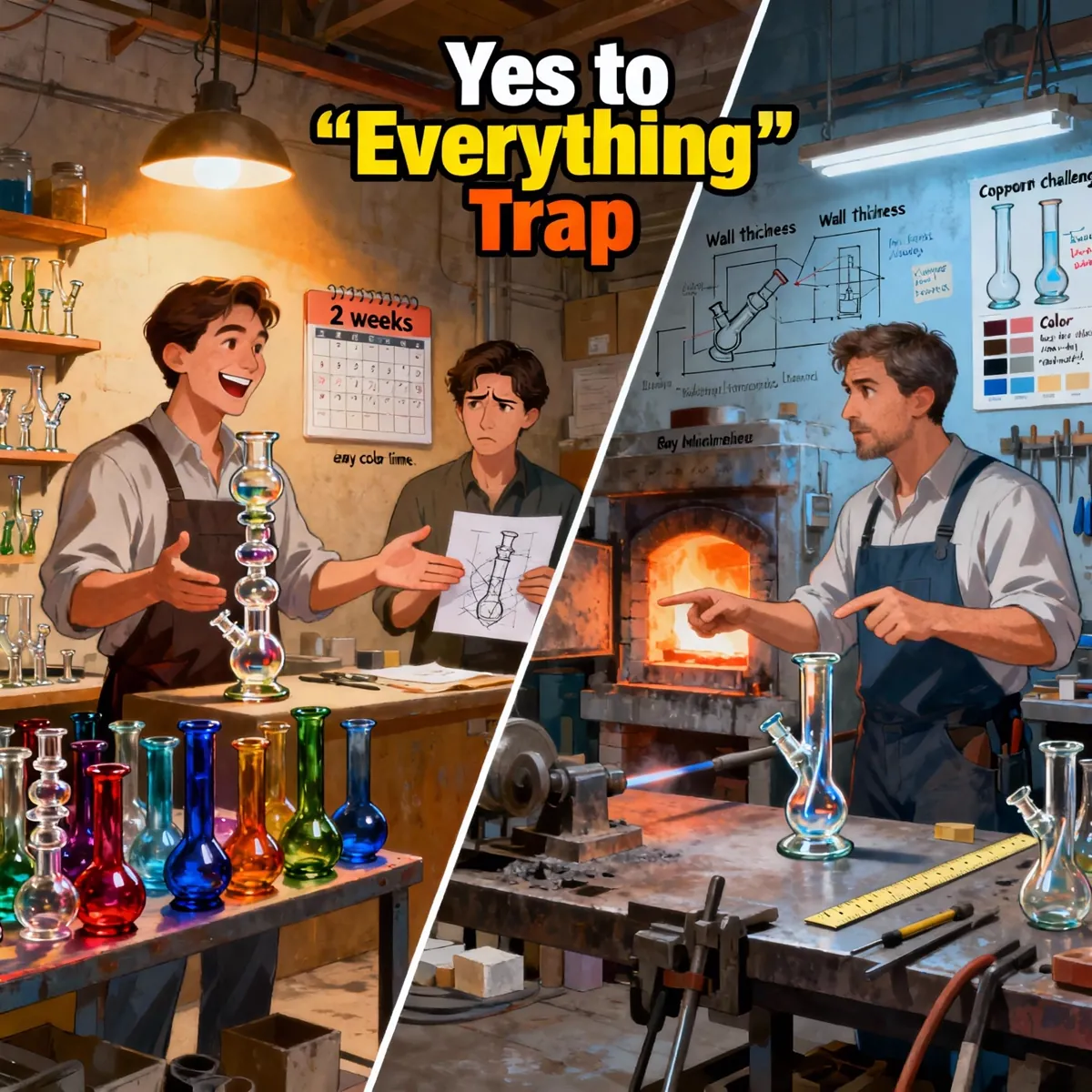
Check 11: Measure Dimensions and Wall Thickness
Verdict: Non-negotiable. Random pulls only, caliper in hand.
Pull random pieces — never the ones the factory sets out for you — and measure them against the locked sample with a digital caliper. Height, width, wall thickness, all at the same points you measured before. Write your tolerance band into the spec sheet so pass and fail become numbers, not opinions.
Hand-blown glass always carries variation. The question is whether the variation stays inside your band. A piece that runs noticeably light usually carries thinner walls, and thinner walls become breakage claims six weeks later — far from anyone who can fix them.
Check 12: Function-Test Joints, Seals, and Airflow
Verdict: Non-negotiable. Looks pass; function fails.
Seat each ground joint on five random pieces and check for rock or visible gap. Fill water pipes, wait five minutes, press the chamber — bubbling is a fail. Draw air through every style you ordered and compare the pull against the approved sample. Any stiffness, rattle, or looseness belongs on the defect list.
Airflow drift is the complaint you cannot photograph, which makes it the easiest one to deny. Test it side by side while the evidence is still in your hands. For dry pieces the draw is the entire experience, and the wholesale hand pipes page covers the styles where airflow tolerance matters most.
Check 13: Inspect Carton Data Before Loading
Verdict: Non-negotiable for sea freight. A quick win on small air shipments.
Count the cartons, weigh them, and photograph the shipping marks before anything leaves the dock. Compare every figure against the packing list. Carton count, gross weight, and box dimensions are the three numbers that decide your freight bill and any shortage claim.
A carton count that disagrees with the packing list is a dispute you want settled before the container seals, not after arrival. Freight follows volume and weight, so surprises here travel straight into landed cost. The import cost breakdown for water pipes shows how each charge connects.
Two Documentation Checks That Protect You
Paper is boring until the day you need it. These two checks turn a he-said-she-said dispute into a lookup. Run them on every order, including the friendly ones.
Check 14: Keep One Written Record Per Order
Verdict: Non-negotiable. Chat screenshots fade; dated PDFs hold.
Give every reorder one file: PO acknowledgment, countersigned spec, first-piece approval, inspection report, packing photos. Route any change to spec, price, or schedule through a written change order that both sides initial. When a dispute arrives months later, the file decides it in minutes.
The record also changes behavior. A supplier who sees you documenting everything answers faster and flags problems earlier, because the paper trail runs both ways. Elfglass signs NDAs before projects start and keeps approvals on file — ask your current supplier to show the same habit.

Check 15: Re-Verify Certifications at Shipment Time
Verdict: Non-negotiable. Certificates expire; shipments still need them.
Dates matter more than logos. Request current copies of BSCI, WRAP, and ISO 9001 before each shipment and read the expiry lines. ISO 9001 describes a working quality-management system, and the official ISO 9001 overview explains what the standard requires.
Elfglass holds all three certifications and refreshes copies on request; a disciplined factory leads with evidence. If yours hesitates, or hands you an expired certificate, you have found the ceiling of their quality system. An expired document is a compliance gap at best and a stalled container at worst. If the checks keep failing, our guide to switching glass pipe suppliers turns the exit into a method instead of a leap.
All 15 Checks in One Table
Copy this reorder supplier checklist into your PO template and run it verbatim on every repeat order. The rows follow the four phases above. Repetition is what turns 15 checks into a habit.
| # | Check | Phase | Verdict |
|---|---|---|---|
| 1 | Re-lock approved sample and spec | Before PO | Non-negotiable |
| 2 | Price validity window | Before PO | Non-negotiable |
| 3 | Payment terms unchanged | Before PO | Non-negotiable |
| 4 | Incoterms and shipping split | Before PO | Non-negotiable |
| 5 | Quantity and packaging math | Before PO | Nice-to-have |
| 6 | Glass lot confirmation | Production | Non-negotiable |
| 7 | First-piece approval | Production | Non-negotiable |
| 8 | Branding method and placement | Production | Nice-to-have |
| 9 | Packaging spec sheet | Production | Non-negotiable |
| 10 | Sampling plan agreement | Pre-shipment | Non-negotiable |
| 11 | Dimensions and wall thickness | Pre-shipment | Non-negotiable |
| 12 | Joints, seals, and airflow | Pre-shipment | Non-negotiable |
| 13 | Carton data before loading | Pre-shipment | Non-negotiable for sea freight |
| 14 | One written record per order | Documentation | Non-negotiable |
| 15 | Certifications current | Documentation | Non-negotiable |
A supplier that clears all 15 without friction has earned something rare: reorder trust backed by evidence. Two or three failures do not end a relationship. They do mean the conversation happens before the deposit, not after. For the questions to ask before that first deposit, see our supplier interview script.
Frequently Asked Questions
When should I start running these reorder checks?
Before you send the PO, not after production starts. Checks 1 to 5 take about an hour and shape everything downstream. By the time goods are packed, your only remaining lever is whether to release the balance payment.
What if my supplier resists pre-shipment inspection?
Treat it as a disqualifying answer. A factory confident in its batch welcomes inspection, and a factory hiding drift delays it. If live video is refused too, start qualifying a backup supplier before you need one.
Do I need to re-test glass material on every reorder?
Ask for written lot confirmation every time, and re-test when the lot changes. A new borosilicate batch can shift clarity, weight, and thermal behavior. Elfglass turns replacement samples in 1 to 3 days, so re-testing stays cheap.
How long should a price lock last with a supplier?
Match the lock to your reorder cadence. Quarterly buyers should ask for a 90-day validity window in writing. Elfglass restates quote validity with every quote and answers within 12 hours, so demand the same paper trail from anyone.
Can I reuse the original approved sample forever?
Yes, if you protect it. Label the sample with the PO number and date, store it away from handling and sunlight, and never ship it back. The day it breaks, formally approve a replacement reference before the next order.
The Second Order Sets the Pattern
Repeat business is where a supplier relationship earns its margin, and where it quietly leaks. The 15 checks above compress that risk into a routine any buyer can run before wiring a deposit. Batch two sets the pattern for batch twenty. If you want to run these 15 checks against a real production schedule, ask Elfglass for a reorder walkthrough before wiring your deposit.
- Lock the reference before money moves: countersigned spec sheet, labeled approved sample, restated price validity, identical payment terms.
- Hold checkpoints inside production: glass lot confirmation, first-piece approval, packaging spec sheet.
- Inspect before you pay: sampling plan agreed first, random pulls measured and function-tested, cartons counted — then release the 70% balance.
- Keep the paper trail: certifications current, approvals archived, every change in writing.
Elfglass applies this exact discipline to its own repeat orders and welcomes inspection on every batch. See the standard in practice across the wholesale hand pipe catalog.
Get a Quote for Your Next Order
Building your wholesale lineup? for a reorder that passes the same checks as your first order? Explore our wholesale water pipe collections for MOQ, tiered pricing, and factory-direct lead times. Send us your product spec and target quantity — contact our factory team or message us on WhatsApp, and we will reply with pricing and lead times within 24 hours.
About the Author
Ava Zeng is the founder of Elfglass, a Shenzhen-based borosilicate glass pipe manufacturer serving B2B brands worldwide. Every guide on this site is grounded in her production-floor experience— the annealing lines, QC checkpoints, and export orders behind each claim.
Before you commit to a supplier, read her founder’s story and trust promise. Then see the guide to vetting a reliable glass pipe manufacturer — the same red-flag checklist Elfglass applies to its own suppliers.
Ready to Source Custom Glass Pipes?
Get a free quote within 24 hours. MOQ from 100 pieces. NDA-protected design consultation.
