
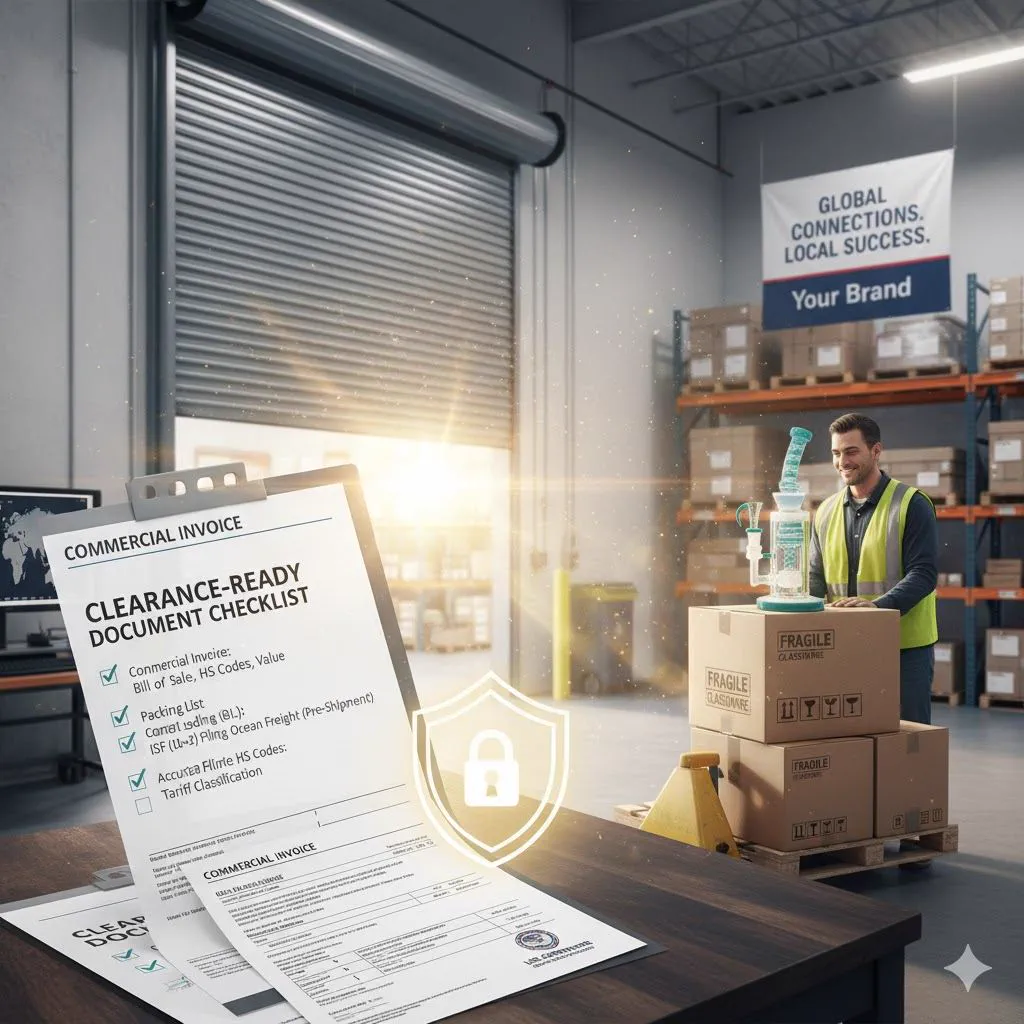

Every year, the same story plays out across the glass pipe supply chain. Importers who planned loosely in summer find themselves scrambling in September for container space that no longer exists. Factories are booked solid. Carriers are levying surcharge on top of surcharge. And somewhere between a missed sailing and a stranded container, an entire quarter’s revenue plan quietly unravels. Peak season logistics is a booking problem, and the booking window starts in summer.
If you are importing glass pipes from China for the October-through-December retail window, Q4 logistics is not a detail you hand off to a freight forwarder at the last minute. It is the single operational variable that determines whether your shelves are stocked or your warehouse is empty when buyers spend the most. Here is how to plan the booking timeline, manage peak season costs, and coordinate with your factory so that nothing slips.
Why Q4 Is the Highest-Stakes Shipping Window
The fourth quarter concentrates more retail demand than any other three-month period. Smoke shops, head shops, and wholesale distributors ramp inventory for holiday gifting, year-end restocking, and new-year product launches. For glass pipe importers, that means every order placed in August or September must arrive, clear customs, and reach the warehouse well before December.
The math is not forgiving. Ocean freight from southern China to the US West Coast runs roughly 25 to 30 days. To the East Coast, add another week. Our port-by-port sea shipping time guide breaks down each lane’s transit window. US customs clearance typically takes several business days when documentation is in order, and domestic ground transport from port to warehouse adds further time. Working backward from a December 1 shelf date, the latest practical vessel departure from China falls in early October at the absolute outside.
But that is the optimistic path. It assumes no production delays, no equipment shortages at the port, no peak season surcharge disputes with your carrier, and no Golden Week disruption. In practice, the window is tighter than the calendar suggests, and the cost of misjudging it is not just a late shipment. It is a quarter of revenue that simply does not happen. That is why speed must be treated as sacred in every supplier relationship.
The Key Dates That Shape Q4 Shipping
Three events define the Q4 logistics landscape for anyone sourcing from China. Missing any one of them compresses your options materially.
Golden Week (October 1 to 7) is China’s National Day holiday. Factories across the country shut down for the full week. Ports and customs offices remain open but operate with skeleton crews. The direct impact is seven days of zero production. The indirect impact is much larger: the three to four weeks before Golden Week see a massive surge in shipping volume as importers worldwide rush to move goods before the shutdown, and the two to four weeks after see a backlog as pent-up orders flood back into the system.
Peak Season Surcharges begin appearing on carrier rate sheets as early as June for ocean freight, but the real impact hits in September and October. Every major carrier, from Maersk to MSC to COSCO, publishes peak season surcharges (PSS) during this window. These are not optional. They are line-item additions to your freight invoice, and they compound on top of any general rate increases (GRI) and bunker fuel adjustments already in effect.
Holiday Retail Deadlines vary by market. In the United States, inventory typically needs to reach distribution centers by late November to participate in Black Friday and Cyber Monday promotions. In the UK and Australia, Christmas is the hard deadline, with retail receiving windows often closing by mid-December. Each market has its own compliance requirements, which we have covered in detail in our USA import compliance guide and Australia compliance checklist. UK buyers follow their own demand patterns too: our UK headshop market trends report for 2026 shows what British shops stock ahead of the holiday stretch.

Understanding Peak Season Surcharges
A peak season surcharge is a temporary fee that ocean carriers add to base freight rates during periods of high demand. Think of it as a congestion price: when everyone is trying to ship at the same time and container space is scarce, carriers charge more for the limited capacity available.
PSS is not the only surcharge that appears in Q4. The typical cost stack for a Q4 ocean shipment from China includes several line items. The base ocean rate itself fluctuates with capacity and demand. On top of that, carriers levy the peak season surcharge, general rate increase announcements that take effect on scheduled dates, bunker adjustment factors tied to fuel prices, and equipment imbalance surcharges when containers are in short supply at specific ports.
| Cost Component | Typical Q4 Behavior | What Drives It |
|---|---|---|
| Base ocean rate | Rises significantly above Q2 levels | Capacity constraints, front-loading by importers |
| Peak Season Surcharge (PSS) | Several hundred to over a thousand dollars per container | Carrier announcement; varies by trade lane |
| General Rate Increase (GRI) | Often announced for September or October | Carrier pricing cycles |
| Bunker Adjustment Factor (BAF) | Fluctuates with fuel oil prices | Global crude oil market |
| Equipment Imbalance Surcharge | Common at origin ports during peak | Container shortage from repositioning delays |
The cumulative effect can add several hundred to over a thousand dollars per container compared with summer baselines. For importers running multiple containers per quarter, that is a material line item that deserves proactive management rather than passive acceptance.
A Month-by-Month Booking Timeline
Here is a practical timeline for Q4 shipping from China, built around the Golden Week disruption and typical ocean transit durations. This assumes you are shipping by sea, which is the most common mode for wholesale glass pipe orders.
| Month | Action | Why It Matters |
|---|---|---|
| Early August | Finalize product selections, confirm sampling, place purchase orders | Locks in production slots before factory backlogs build |
| Mid-August | Confirm production schedules with your supplier; begin packaging spec review | Ensures your order is queued ahead of the pre-Golden Week rush |
| Late August | Book cargo space with your freight forwarder; arrange inland transport | Space is still available; rates have not yet peaked |
| Early September | Production completes; quality inspection; container loading | Loading before late September avoids the worst of the pre-Golden Week port congestion |
| Mid-September | Vessel departs; submit customs documentation | Clears before Golden Week port slowdowns begin |
| October | In-transit; monitor vessel tracking; prepare for arrival | Golden Week delays affect only orders still at origin |
| November | Arrival at destination port; customs clearance; final delivery | Inventory reaches warehouse before holiday retail peak |
If your order is still in production during October, you are already behind the ideal schedule. The production lead time for a 100-unit glass pipe order is typically 7 to 12 days from design confirmation, but during Q4, factories are juggling hundreds of orders simultaneously. Adding even a few days of buffer to your production estimate is prudent.
Sea vs Air vs Express: Choosing the Right Mode
Not every Q4 shipment needs to go by sea. The right mode depends on order size, urgency, and how much of the peak season rate spike you are willing to absorb. Here is how the three main options compare for glass pipe imports.
| Mode | Relative Cost | Transit Time | Best For |
|---|---|---|---|
| Sea freight (FCL) | Lowest per-unit cost | 25-40 days depending on destination | Full container orders of 100+ units per SKU; standard wholesale restocking |
| Air freight | Significantly higher | Roughly a week | Mid-size urgent orders; supplementing a sea shipment that arrived short |
| Express (DHL, FedEx, UPS) | Highest per-kg cost | A few business days | Samples, small replenishment orders, emergency restocking |
For large wholesale orders of wholesale water pipes, hand pipes, or dab rigs, sea freight is almost always the right default. The per-unit cost advantage is substantial, and a well-timed booking in August or early September avoids the worst of the Q4 rate spike.
Air freight becomes relevant when you have underestimated demand and need a bridge shipment to cover a gap. During Q4, air cargo capacity also tightens, and passenger belly-hold space decreases as airlines adjust schedules. If air is your plan, book at least two to three weeks ahead and expect rates to carry a peak premium of their own.
Express is rarely economical for wholesale glass pipe orders due to the weight and volume of the product. It makes sense for samples, replacement parts, or small accessory orders. If you are evaluating your first order with a new supplier, express shipping for samples keeps the timeline short while you evaluate quality before committing to a full container.
For a deeper look at how freight costs fit into your total landed cost, our cost of importing guide breaks down each component from FOB to final delivery.
Packaging and Freight Planned Around Your Route
From foam-insert and double-wall cartons to air or sea freight with clear Incoterms, we engineer packaging to cut breakage and quote landed cost honestly. Send us your destination and volume for a packing plan.
MOQ from 100 pieces | BSCI / WRAP / ISO 9001 | NDA before every project
How to Manage Rising Freight Costs
You cannot eliminate peak season surcharges, but you can reduce their impact on your per-unit cost. Several strategies are available to any importer willing to plan ahead.
Consolidate into larger containers. A 40-foot high-cube container costs more in absolute terms than a 20-foot unit, but the per-unit shipping cost drops significantly. If your Q4 order plan includes multiple SKUs across water pipes, hand pipes, and accessories, consolidating them into a single 40HQ is almost always cheaper than booking two separate 20-foot loads.
Consider LCL for smaller orders. If your order is small enough that a full container would ship mostly empty, less-than-container-load shipping may be more practical. LCL rates per cubic meter are higher than FCL equivalents, but the total outlay is lower, and you avoid the cost of shipping unused space.
Lock rates early. Some freight forwarders offer rate-lock options with short validity windows. If your forwarder offers this, use it. A locked rate in August protects you from the September spike even if your cargo ships in October.
Time your orders around surcharge windows. If your production schedule allows, shipping in late August (before the heaviest PSS period) or in late November (after the Golden Week backlog clears) can save meaningful money compared with shipping in the September-October peak.

Communicating Q4 Deadlines to Your Supplier
Your factory is managing hundreds of orders during Q4, not just yours. Clear, early communication about your timeline is the single most effective way to avoid production delays that cascade into missed sailings.
Start by sharing your target delivery date, not just your order details. If you need inventory in your warehouse by November 15, tell your supplier that explicitly and work backward together: 5 days for customs and domestic transport means the vessel must arrive by November 10; 30 days of ocean transit means departure by October 10; 7 to 12 days of production means the order must enter the queue by late September at the latest; and sampling and approval must close by mid-September.
Request a written production schedule that confirms each milestone. A quick photo update when production begins and when it finishes costs your supplier nothing but gives you early warning if things are slipping. Most factories are willing to provide this if you ask at the order stage rather than chasing updates after the fact.
On payment timing, standard terms are T/T with a 30 percent deposit to start production and the 70 percent balance before shipment. During Q4, have the balance payment ready to process quickly once inspection passes. Factories that hold ISO 9001 certification make this step cleaner: documented inspection records give you a clear pass-fail trail instead of a phone-call debate. A payment delay of even a few days can push your loading date past a critical sailing cutoff.
For more on how MOQ and order sizing interact with production scheduling, our MOQ 100 trial order guide covers the economics of starting with a manageable first order.
Packing Considerations for Fragile Glass Cargo
Glass pipes, water pipes, and dab rigs are durable products in use, but they demand careful handling during transit. The Q4 shipping environment, with its compressed timelines and overloaded containers, increases the risk of damage if packing is treated as an afterthought.
Your factory should follow a defined packing protocol for glass cargo. Individual piece dividers prevent contact between items. Double-wall corrugated boxes provide structural protection. Corner protectors on pallets absorb impact from forklift handling. Clear fragile markings on every outer carton ensure that ground handlers know the contents demand care.

Before your Q4 order goes into production, confirm the packing plan with your factory in writing. Do not assume it. During peak season, factories may substitute materials or skip steps to save time, and a packing shortcut that costs nothing to specify can cost thousands in damaged product.
Container loading matters too. Heavier items on the bottom, no gaps between pallets, and moisture barriers for temperature-sensitive shipments during Q4 ocean transit are all standard practice. If you are shipping a full container, request loading photos so you can verify the arrangement before the doors close.
Finally, review your marine cargo insurance policy. Standard coverage typically costs 0.3 to 0.5 percent of the declared cargo value, but you need to confirm that it explicitly covers breakage for glass products. Some standard policies exclude fragile goods unless specifically endorsed. The cost of adding breakage coverage is small relative to the value of the cargo it protects.
Your Pre-Booking Checklist
Use this checklist before you confirm any Q4 shipment with your supplier or freight forwarder.
| Item | Status |
|---|---|
| Product designs and specifications finalized | Confirmed before production starts |
| Sampling approved and signed off | Physical sample or photo approval on file |
| Purchase order placed with confirmed production dates | Written schedule from factory |
| Deposit paid (T/T 30%) | Receipt confirmed by supplier |
| Packing protocol agreed in writing | Divider, box, and pallet spec documented |
| Cargo space booked with forwarder | Booking confirmation with vessel and cutoff date |
| Quality inspection scheduled before loading | Third-party or in-house inspection date set |
| Customs documentation prepared | Commercial invoice, packing list, certificate of origin ready |
| Marine cargo insurance confirmed with breakage coverage | Policy endorsement for fragile goods verified |
| Balance payment (T/T 70%) ready for release after inspection | Funds available to avoid loading delays |
Start Your Q4 Order with Elfglass
If you are planning Q4 inventory for your smoke shop or distribution business, the window to act is now. Elfglass is a B2B glass pipe manufacturer established in 2010, holding BSCI, WRAP, and ISO 9001 certifications. We offer a minimum order of 100 pieces per SKU, sampling in 1 to 3 days, and production lead times of 7 to 12 days for orders above 100 units. Our team responds to quote requests within 12 hours.
Whether you need wholesale water pipes, hand pipes, dab rigs, or custom OEM pieces, our wholesale water pipes collection is a good place to start exploring. Reach out with your product requirements and your target delivery date, and we will build a production and shipping plan that accounts for every Q4 variable covered in this guide.
Frequently Asked Questions
When is the latest I can ship from China for Q4 delivery?
For ocean freight to the US West Coast, the latest practical departure is early October to arrive before December. To the US East Coast, aim for mid-September. For European and Australian markets, late October departures are workable if customs clearance proceeds smoothly. Booking cargo space should happen in late August to avoid peak season capacity constraints.
What is a peak season surcharge and how much does it add?
A peak season surcharge (PSS) is a temporary fee that ocean carriers add to base freight rates during high-demand periods, typically June through October for ocean shipping. The amount varies by carrier and trade lane, but importers should expect several hundred to over a thousand dollars per container in additional costs during Q4, on top of any general rate increases already in effect.
How does Golden Week affect shipping from China?
Golden Week (October 1 to 7) shuts down factories across China for a full week. Ports operate with reduced staff. The three to four weeks before the holiday see a volume surge as importers rush to ship before the closure, and the two to four weeks after see a backlog as pent-up orders flood back into the system. Orders in production during Golden Week will be delayed by at least one to two weeks.
How far in advance should I book container space for Q4?
Book container space at least 3 to 4 weeks before your target loading date. For Q4 shipments, this means contacting your freight forwarder in late August to secure space for September and October loadings. Booking later than September risks limited availability and higher rates as peak season demand intensifies.
What should I check in my shipping insurance for glass products?
Confirm that your marine cargo insurance policy explicitly covers breakage for glass products. Standard policies may exclude fragile goods unless specifically endorsed. Coverage typically costs 0.3 to 0.5 percent of the declared cargo value. Also verify that the policy covers the full declared value of the shipment, not just a depreciated or book value.
Get a Quote for Your Next Order
Booking Q4 shipments and need lead-time certainty? Send us your product spec and target quantity — contact our factory team or message us on WhatsApp, and we will reply with pricing and lead times within 24 hours.
About the Author
Ava Zeng is the founder of Elfglass, a Shenzhen-based borosilicate glass pipe manufacturer serving B2B brands worldwide. Every guide on this site is grounded in her production-floor experience— the annealing lines, QC checkpoints, and export orders behind each claim.
Before you commit to a supplier, read her founder’s story and trust promise, and the guide to vetting a reliable glass pipe manufacturer— the same red-flag checklist Elfglass applies to its own suppliers. When the order arrives at your warehouse, follow a arrival inspection protocol to catch defects before they become losses.
Peak-season capacity constraints follow the logistics cycle, where carrier space is allocated months in advance during Q4 surges.
Ready to Source Custom Glass Pipes?
Get a free quote within 24 hours. MOQ from 100 pieces. NDA-protected design consultation.
