
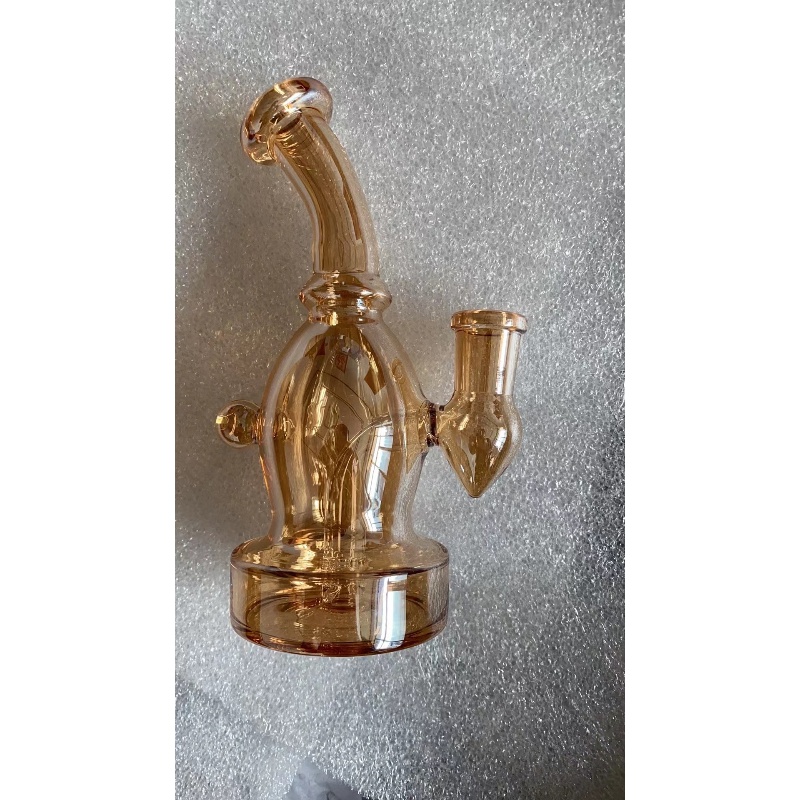
Water filtration here follows the basic water-pipe principle—smoke drawn through water before reaching the user—which is documented in standard references (water pipe design reference).
Ice Pinch Design: Small Feature, Big Selling Point
A Saturday afternoon in your shop. A customer lifts two water pipes off the wall, one in each hand. Same height. Similar color. One neck carries three small dents; the other is smooth. She tilts the dented neck toward the light and asks, “What are these for?”
Your answer takes two seconds: “Ice sits there.” She instantly pictures cubes chilling every hit. Five minutes later she checks out with the ice pinch model — the one with the higher price tag. Nobody even discussed a discount.
I have watched that scene play out hundreds of times since entering the glass trade in 2010. A few small dents — the ice pinch — tip buying decisions every single day. The feature costs pennies to produce and adds real dollars at retail. That gap is your margin.
This guide covers what buyers actually need: what an ice pinch is, how it cools smoke, how it gets made, and which versions deserve shelf space.
What Is an Ice Pinch?
An ice pinch is a set of inward dents pressed into the neck of a water pipe. They form a narrow shelf that holds ice cubes above the waterline. Drop two or three cubes in, tilt the pipe back, and the ice parks itself directly in the smoke path.
Terminology shifts by region, brand, and marketplace listing. Here is the map we use with buyers:
- Ice pinch — the standard trade term, named after the forming technique
- Ice catcher — common in US retail marketing; the feature “catches” the ice
- Ice notches — refers to the individual dents; a “3-notch pipe” has three pinches
- Ice ridge — used when the pinches merge into a near-continuous raised ring
Placement is dictated by physics. The pinch always sits inside the main tube, between the waterline and the mouthpiece. We set the pinch zone four to six centimeters below the mouth rim: far enough from the lips to feel comfortable, close enough to chill smoke in its final stretch. Among the different types of glass pipes, only water pipes carry this feature at all.
One caution: in marketplace listings, check the photos. Some sellers use “ice catcher” for a removable insert accessory instead of a pinched neck.

How Ice Cooling Works
Two mechanisms do the work: contact cooling and meltwater support. Elfglass stocks water pipe designs with ice notches in its wholesale water pipes catalog, available for OEM adaptation.
Contact cooling is the headline act. Smoke leaves the water chamber filtered but still warm. When the draw pulls that smoke across the ice, heat transfers into the cube surfaces, and the smoke reaches the mouthpiece noticeably cooler. Cooler smoke feels smoother on the throat — less scratch, less coughing.
Meltwater support is the quiet bonus. As cubes melt, droplets fall into the main chamber and add to the filtration water, trapping more particulate and keeping things fresher across a long session.
Here is my operator’s take. Ice cooling is the cheapest smoothness upgrade in the category — no extra percolator, no extra chamber, just a pocket for frozen water. A well-tuned percolator diffuses smoke harder, but it adds cost, drag, and cleaning chores. Ice delivers a visible benefit at almost zero cost. That is why it sells.
Ice Pinch vs No Ice Pinch
Every factory tour brings the same question: “Is the extra step really worth it?” The table below is my answer.
| Factor | With Ice Pinch | Without Ice Pinch |
|---|---|---|
| Cooling | Ice-driven chill on demand | Water filtration only |
| Throat harshness | Noticeably smoother, especially on big draws | Standard; can feel warm in long sessions |
| Draw resistance | Slightly higher when ice is loaded; unchanged when empty | Minimal and consistent |
| Cleaning | Extra attention around the notch zone | Standard routine |
| Unit manufacturing cost | Small labor and gas increment | Baseline |
| Retail appeal | Demonstrable feature; easy upsell story | Sells on shape, color, and price alone |
The economics matter more than the physics. The pinch step adds a small cost at the factory. At retail, the identical silhouette with an ice pinch routinely shelves a price tier higher, because customers see and understand the benefit instantly. Visible features sell themselves. Invisible ones need a pitch.
A warning before you convert your whole wall. Some purists and a few export markets prefer clean, unobstructed tubes. Stock both versions. But give the ice pinch models the eye-level shelf.
Manufacturing Considerations
A good ice pinch is engineering, not decoration. Four variables decide whether the feature works or annoys.
Placement. The pinch zone must sit above the maximum waterline — high enough that waves never splash the ice — and below the mouthpiece with comfortable lip clearance. Miss that window and you get either a wet mouth or a useless shelf.
Glass thickness. Pinching stretches the wall. A craftsperson heats the neck and presses inward with a shaped tool, controlling how thin each dent becomes. Too thin, the notch becomes a weak point. Too thick, the shelf cannot grip the cube.
Notch count changes behavior. Here is how we spec them:
| Notch Count | Ice It Holds | Best For | Trade-off |
|---|---|---|---|
| 2 notches | 1-2 large cubes | Compact tubes, budget lines | Cubes can rotate and partially block airflow |
| 3 notches | 2-3 standard cubes | Most water pipes — our default recommendation | Balanced grip and airflow |
| 4 notches | 3+ cubes or crushed ice | Premium and tall pieces | Tighter draw; slower cleaning |
Hand-pinched vs mold-formed. Hand-pinching lets a craftsperson tune each pipe — placement, depth, angle. That suits premium lines where character matters. Mold-formed pinches come out identical, batch after batch, which is what OEM volume demands. We run both: hand work for signature series, molds for the volume orders inside our 10,000-piece monthly capacity.
Insider warning: a pinch formed too deep narrows the airway and produces a whistling draw. Test every new mold with real cubes before you approve production. Ten minutes of testing beats a container of returns.

Design Variations
Three families dominate the market.
Single row vs multiple rows. The standard is one row of notches holding a single layer of cubes. Taller pipes can carry two rows — one lower, one higher — stacking ice for long sessions. Double rows cost more to form, but they justify a premium tag with a story customers can see.
Removable ice catchers. Some designs skip pinched glass entirely and use a separate part — a glass clip or fitted collar that inserts into the neck. The upside: you can retrofit existing inventory. The downside: one more part to lose, break, or mismatch. We recommend removable catchers as accessories only, never as the flagship feature.
Integrated pinch vs collar designs. An integrated pinch is formed from the pipe’s own glass — permanent, clean-looking, zero added parts. A collar design wraps a separate glass ring around the tube and squeezes inward. Collars look striking and open color-play options, but they add a joint — and joints are where cracks start.
Want an ice pinch design your competitors cannot copy?
Elfglass builds OEM and ODM water pipes with custom molds held exclusively for your brand. A sketch, a sample, or even a rough idea is enough to start. Our Shenzhen factory has made glass pipes since 2010, with 10,000 pieces of monthly capacity across water pipes, hand pipes, dab rigs, and parts & accessories.
Send us your spec sheet and get a quote within 12 hours. Contact Elfglass today.
Stock the Glass Pipes Your Customers Actually Buy
Elfglass produces the full wholesale catalog, from hand pipes and sherlocks to dab rigs, percolator bongs, and accessories, in proven best-selling specs. Tell us your market and we will recommend a catalog mix with pricing.
MOQ from 100 pieces | BSCI / WRAP / ISO 9001 | NDA before every project
Compatibility Across Pipe Types
The ice pinch plays well with some silhouettes and fights with others. After sixteen years of production, here is our fit map.
Beaker pipes. Excellent hosts. The flared base stays stable under a full ice load, and most beaker necks are wide enough for three generous notches. If your customers value stability over slim looks, start here — our breakdown of beaker vs straight tube stability covers the trade-offs.
Straight tubes. The classic pairing. A straight cylinder gives ice room to shift and melt evenly, and this is the silhouette most buyers picture when they hear “ice catcher.”
Recyclers. Handle with care. Recyclers cycle water between chambers, and extra meltwater can shift that balance. A poorly placed pinch can flood the recycle loop or starve it. We flow-test every recycler design before adding ice. Read our explainer on how recycler bongs work before ordering this combination.
Mini rigs. Possible, but limited. Compact necks squeeze ice capacity down to a cube or less, and the feature loses much of its impact. Our comparison of mini vs full-size water pipes helps you judge whether a pinch earns its spot on smaller formats.
Hand pipes. Not applicable. No water chamber, no neck, nowhere to put ice. If a supplier pitches you an “ice catcher dry pipe,” walk away — they are selling a misunderstanding.
Quality Checks
Every ice pinch pipe that leaves our floor passes four inspections. Ask your supplier if they run the same list. If they hesitate, find another supplier.
1. Notch symmetry. Cubes must sit level across all notches. Asymmetric pinches let ice slide sideways and block the airway mid-session. We gauge each row against a template.
2. Load test. We load the pinch zone with a standard weight of cubes and simulate a tilted draw. The ice must stay parked. If a cube drops through under a gentle shake, the notch depth fails.
3. Airflow clearance. With cubes loaded, a gauge rod must still pass through the neck. Draw resistance has to stay comfortable — nobody pays good money for a pipe that fights them.
4. Stress inspection after annealing. Pinch dents are stress concentrators by design. The annealing oven relieves that stress, and we inspect every batch afterward. A rushed anneal schedule leaves invisible tension behind — and the crack shows up weeks later, on your customer’s counter instead of our factory floor. That return damages your reputation, not ours.

Why Retailers Should Stock Ice Pinch Models
Three retail advantages. None of them requires a sales deck to see.
It demos itself. “Add ice for cooler hits” is a one-breath explanation, and the customer proves it in their very first session. A shelf card with that line does more work than a paragraph of specs. Put a display unit loaded with a few cubes under good light, and browsers stop.
The silent upsell. Stock the same silhouette with and without the pinch, side by side. The customer compares, understands, and usually reaches for the featured version. No pressure. No script. The product sells itself.
Assortment depth. One feature family spans three price tiers: entry straight tubes, mid-range beakers, premium double-row pieces. Your wall stays coherent and your ordering stays simple.
My advice: give the pinch models the eye-level shelf and watch which versions sell out first. Reorder on evidence, not habit. Stores that treat ice as a checkbox order once and forget. Stores that treat it as a strategy build a category.
Customizing the Ice Pinch for Your Brand
A stock ice pinch is a commodity. A custom one is a moat. Since 2010, Elfglass has built OEM and ODM programs around that exact logic: small design decisions, locked to your brand.
| Element | Your Options | Notes |
|---|---|---|
| Notch count | 2, 3, or 4 per row | Standard counts need no mold change |
| Pinch depth | Shallow, standard, deep | Deep grip for heavy ice users |
| Pinch position | Upper neck, mid neck | Set at the mold stage |
| Row count | Single, double | Double rows suit premium lines |
| Mold ownership | Exclusive to your brand | Your mold is never resold |
| Logo placement | Near pinch, base, or neck | Decal, sandblast, or color accents |
Exclusivity is the part buyers ask about most. When you commission a custom mold at Elfglass, that mold belongs to you alone. No competitor can reorder your notch profile, your depth, or your placement. In a market full of lookalikes, that is real shelf defense.
Capacity check: our Shenzhen factory produces 10,000 pieces per month, and samples get approved before bulk runs. Send us sketches, photos, or a physical sample. Our team turns it into a spec sheet and a quote.
Conclusion: Your Ice Pinch Stocking Checklist + FAQ
Time to turn this into an order. Here is the checklist we would use if we were restocking a shop today:
- Volume driver: three-notch straight tubes. The safest ice order you can make.
- Stability play: beaker-based ice models for customers who hate wobbly pipes.
- Top shelf anchor: one premium double-row or collar design to lift price perception.
- Skip: ice features on hand pipes entirely; flow-test every recycler before ordering.
- Test: run with-pinch and without-pinch versions side by side, then reorder by evidence.
- Protect: if your volume supports it, lock an exclusive mold so the design stays yours.
Small feature. Big margin. The ice pinch earns its place on any serious water pipe wall — and Elfglass has spent sixteen years perfecting it. Bring us your idea, and we will build the version your competitors cannot copy.
Frequently Asked Questions
What is an ice pinch on a bong?
An ice pinch is a set of inward glass dents formed in the neck of a water pipe. They hold ice cubes above the waterline so smoke passes over the ice on every draw. The feature is also called an ice catcher, ice notches, or an ice ridge.
Do ice catchers fit all bongs?
No. The neck must be wide enough to hold cubes, and the pipe must have a water chamber below it. Beaker and straight-tube water pipes are ideal hosts. Hand pipes cannot use ice at all, and most recyclers need flow testing before an ice feature is added.
How does ice cooling work?
Contact cooling does most of the work. As smoke passes over the cubes, heat transfers into the ice and the draw feels cooler. Meltwater also drips into the chamber and adds filtration volume. Together, the two effects make hits feel smoother on the throat.
How many ice notches should a water pipe have?
Three is the standard recommendation. Three notches cradle standard cubes securely without choking airflow. Two notches suit compact budget pieces. Four notches grip crushed ice but tighten the draw and slow down cleaning.
Is an ice pinch better than a percolator?
They solve different problems. An ice pinch chills smoke cheaply and visibly, with almost no added draw resistance. A percolator diffuses smoke into fine bubbles for deeper filtration. Premium pipes often combine both. See the Elfglass percolator comparison guide for details.
About the Author
Ava Zeng is the founder of Elfglass, a Shenzhen-based borosilicate glass pipe manufacturer serving B2B brands worldwide. Every guide on this site is grounded in her production-floor experience — the annealing lines, QC checkpoints, and export orders behind each claim. Ice-pinch durability depends on how well the glass handles temperature swings, a property studied in thermal shock research where rapid cooling creates stress points.
Ready to Source Custom Glass Pipes?
Get a free quote within 24 hours. MOQ from 100 pieces. NDA-protected design consultation.
