

If you source glass pipes from China and sell them in regulated markets, certifications are not optional paperwork See also our EU import compliance for glass pipes.—they are the difference between a container clearing customs and one getting held at the port. Yet most B2B buyers discover glass pipe certifications only after a retailer, distributor, or customs agent asks for proof. By then, switching suppliers means lost time, wasted sampling costs, and delayed launches. Quality management terms in this glossary follow the definitions used by the ISO 9001 quality management family, the baseline set of quality standards published by the International Organization for Standardization.
This glossary breaks down the four certifications that matter most in the glass pipe trade: BSCI, WRAP, ISO 9001, and RoHS. Each section explains what the standard covers, why buyers request it, and how to tell a legitimate certificate from a PDF someone edited in Photoshop. The goal is simple—so you can evaluate any supplier’s compliance profile in a single conversation instead of three email chains.
Why Glass Pipe Certifications Matter More Than Ever
Regulatory scrutiny on smoking accessories has tightened across every major import market over the past five years. The United States updated its PACT Act enforcement guidelines, Australia introduced new compliance checklists for imported glass goods, and the United Kingdom post-Brexit built its own product safety framework separate from EU directives. Canada followed with additional requirements under its consumer safety statutes.
For wholesale buyers, this patchwork of regulations means your supplier’s certifications serve as your first line of defense. A factory that can produce valid, independently audited certificates for social compliance, quality management, and material safety is a factory that respects process. That matters when a customs officer in Los Angeles or a trading standards officer in Manchester asks why your shipment contains glass articles marketed for tobacco use.
Beyond legal compliance, certifications also function as a commercial filter. Large retail chains in Europe and North America increasingly refuse to onboard suppliers that cannot demonstrate third-party audits. If you are building a brand that will eventually sit on dispensary shelves or in head shop chains, starting with a certified manufacturer gives you documentation you can forward to any compliance team without starting from scratch.
For a deeper look at how these regulations affect specific import corridors, the guides on importing glass pipes to the USA under the PACT Act and the Australian compliance checklist walk through country-specific requirements in detail.
BSCI: The Social Compliance Standard European Buyers Demand
BSCI stands for the Business Social Compliance Initiative, now officially rebranded as amfori BSCI. It is a monitoring system developed by amfori, the European trade association, to help companies verify that their suppliers meet agreed-upon social performance standards. The audit covers thirteen performance areas drawn from international conventions: freedom of association, collective bargaining, non-discrimination, fair remuneration, working hours, occupational health and safety, child labor protections, special protections for young workers, environmental management, and ethical business behavior, among others.
For glass pipe manufacturers in Shenzhen and the broader Guangdong region, achieving BSCI certification requires opening the factory floor to an independent auditor approved by amfori. The auditor interviews workers, reviews payroll records, inspects fire exits and ventilation systems, and checks that the factory’s management systems can sustain compliance over time—not just on audit day.
What BSCI Means for Glass Pipe Buyers
European importers are the primary drivers of BSCI demand. German, French, Dutch, and Scandinavian retailers frequently list BSCI membership as a prerequisite in their supplier onboarding documents. If you sell to European head shops, smoke shops, or lifestyle brands that carry glass accessories, your buyer’s compliance department will almost certainly ask whether your manufacturer holds a valid BSCI audit.
A BSCI audit result is not a simple pass or fail. The auditor assigns a rating from A (best) to E (worst) based on the number and severity of non-conformities. Most European buyers accept a rating of A, B, or C. A D or E typically triggers a corrective action plan with a follow-up audit within six months. When you request a supplier’s BSCI documentation, always check the rating and the audit date—certificates are valid for two years, but buyers often want to see evidence of continuous improvement.
Elfglass holds BSCI certification and welcomes buyers to verify the audit status directly. The buyer’s guide to verifying BSCI certification explains step by step how to check the amfori database and what to look for in the audit report.
WRAP: Responsible Production for the Global Market
WRAP stands for Worldwide Responsible Accredited Production. Originally developed for the apparel and textile industry, WRAP has expanded its scope to include manufacturers in other consumer goods categories, including glass products. The certification is administered by an independent nonprofit board and focuses on twelve principles of responsible production.
These twelve principles cover workplace conditions (compliance with laws and regulations, forced labor, child labor, harassment and abuse), environmental practices (waste management, energy consumption, emissions), and business ethics (customs compliance, illegal transshipment, document security). The WRAP audit process includes a self-assessment by the factory, a review by a WRAP-accredited monitoring organization, and an on-site inspection.
WRAP vs. BSCI: What Is the Difference?
Buyers often ask whether WRAP and BSCI are interchangeable. The short answer is no. They overlap significantly in their coverage of labor rights and workplace safety, but they differ in structure, governance, and geographic emphasis. BSCI is driven by European trade associations and is dominant in EU supply chains. WRAP was developed in the United States and remains more widely recognized by North American brands and retailers.
Some buyers accept either certification. Others specify one or the other based on their end market. A glass pipe brand selling primarily through American smoke shop chains may find that WRAP satisfies their compliance requirements, while the same brand expanding into European markets will need BSCI. Having both certifications, as Elfglass does, removes the guesswork and lets buyers in any market move forward without additional audit requests.
For a complete breakdown of what the WRAP audit involves and how to interpret the certificate your supplier provides, read the WRAP certification explainer for importers.
ISO 9001: The Quality Management Baseline
ISO 9001 is the international standard for quality management systems (QMS). Published by the International Organization for Standardization, it specifies requirements for a QMS that demonstrates the ability to consistently provide products that meet customer and applicable statutory and regulatory requirements. Unlike BSCI or WRAP, ISO 9001 does not address social compliance or labor conditions. It focuses entirely on process quality.
For a borosilicate glass pipe factory, ISO 9001 certification means the manufacturer has documented procedures for every stage of production—from raw material inspection (verifying the grade and purity of glass tubing) through forming, annealing, quality control, packaging, and shipment. Each process has defined inputs, outputs, and checkpoints. Deviations are recorded, investigated, and corrected through a formal non-conformance procedure.
Why ISO 9001 Matters in Glass Pipe Manufacturing
Glass pipe production involves variables that directly affect product safety and durability. Annealing temperature and duration determine whether the glass retains internal stresses that could cause cracking during normal use. Wall thickness consistency affects heat resistance. The quality of joints between different glass components determines whether the piece holds up under repeated heating and cooling cycles.
An ISO 9001-certified factory has systems in place to control these variables consistently across production runs. When you order 100 pieces of a design today and reorder the same design three months later, the quality management system is what ensures the second batch matches the first. This is particularly important for brands that build their reputation on consistent product quality across wholesale orders.
Elfglass has held ISO 9001 certification since its early years of operation. The factory’s quality management processes are documented on the ISO 9001 for glass factories page, where you can see how the standard translates to daily production-floor practices in a Shenzhen borosilicate workshop.
RoHS: Material Safety for Restricted Markets
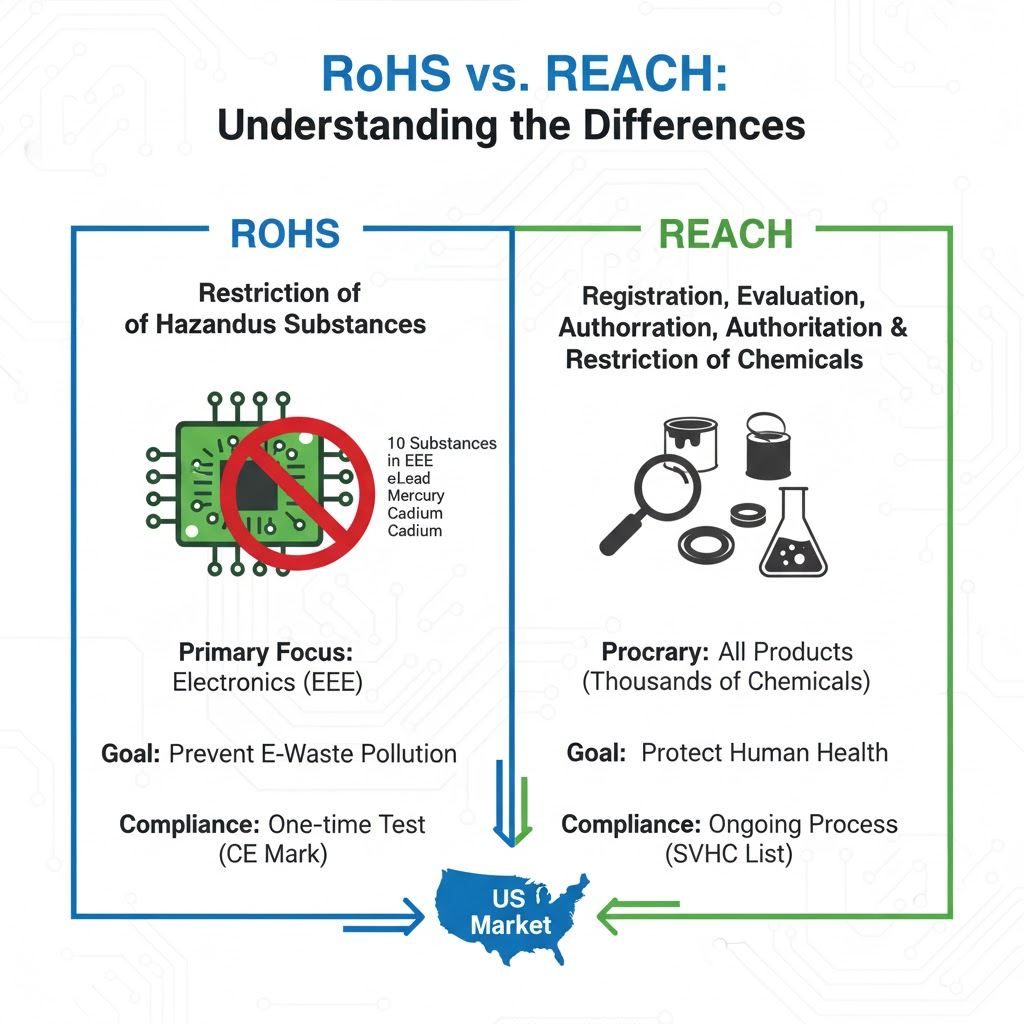
RoHS stands for Restriction of Hazardous Substances. The directive originated in the European Union (Directive 2002/95/EC, later recast as 2011/65/EU, known as RoHS 2) and restricts the use of specific hazardous materials found in electrical and electronic products. The restricted substances include lead, mercury, cadmium, hexavalent chromium, polybrominated biphenyls (PBB), polybrominated diphenyl ethers (PBDE), and four additional phthalates added under RoHS 2 (DEHP, BBP, DBP, DIBP).
At first glance, RoHS may seem irrelevant to glass pipes, which are not electronic devices. However, certain glass pipe designs incorporate metal components—stainless steel downstems, brass fittings, aluminum screens, or decorative elements with metallic coatings. If your product includes any of these components and is sold in a market that enforces RoHS (the EU, UK, and several US states have their own versions), the entire article must comply with the substance concentration limits.
RoHS as a Buyer Consideration
RoHS is an industry certification that buyers may encounter when sourcing glass pipes with mixed-material construction. It is important to note that RoHS compliance is product-specific, not factory-specific. A manufacturer may produce some RoHS-compliant products and others that are not, depending on the materials used in each design.
If your product line includes glass pipes with metal components destined for European or certain North American markets, you should request RoHS test reports from your supplier for each specific product. These reports are typically generated by third-party testing laboratories such as SGS, TUV, or Intertek. The test report should reference the exact product model and list the concentration of each restricted substance.
For all-glass pipes made entirely from borosilicate glass without metal fittings, RoHS testing is generally not required. However, some buyers in regulated markets prefer to have a baseline material safety test regardless, and a supplier willing to accommodate those requests demonstrates the kind of flexibility that makes long-term sourcing relationships work.
Ship-Ready Compliance Documentation
Elfglass supplies the material declarations, certifications, and export paperwork your customs broker needs for the US, UK, EU, Canada, and Australia. Ask us which documents accompany your order before you buy.
MOQ from 100 pieces | BSCI / WRAP / ISO 9001 | NDA before every project
How Certifications Intersect Across Import Markets
No single certification covers every requirement in every market. The table below provides a simplified view of which certifications tend to matter most by destination region. This is not legal advice—regulations change, and specific product categories may trigger additional requirements—but it gives buyers a starting framework for conversations with their suppliers.
| Certification | Europe (EU/UK) | North America | Australia/NZ | What It Covers |
|---|---|---|---|---|
| BSCI | High demand | Occasionally requested | Rarely requested | Social compliance, labor rights, environmental management |
| WRAP | Recognized but secondary | Moderate demand | Rarely requested | Responsible production, 12 principles |
| ISO 9001 | Expected baseline | Expected baseline | Expected baseline | Quality management systems |
| RoHS | Required for mixed-material products | Required in some states | Case by case | Restricted substance limits in materials |
Buyers importing into multiple markets should prioritize suppliers who hold the broadest certification portfolio, since maintaining separate supplier relationships for different destinations adds cost and complexity. Elfglass’s combination of BSCI, WRAP, and ISO 9001 certifications positions it to serve buyers across Europe, North America, and other markets without requiring separate compliance documentation for each region.
For importers shipping to Canada specifically, the Canada compliance guide covers additional considerations that may apply alongside these certifications.
How to Verify a Supplier’s Certifications
Requesting a PDF of a certificate is not verification. Sophisticated forgery tools make it trivially easy to produce a convincing-looking certificate with fabricated details. Proper verification requires going to the source—the database maintained by the issuing organization.
BSCI verification: amfori maintains a database of all member companies and their audit results. You can search by the supplier’s name or amfori member ID to confirm that the audit is current and to see the rating. The audit report itself is typically shared under NDA, so your supplier should be willing to provide it once you have established a business relationship.
WRAP verification: WRAP maintains a publicly searchable directory of certified facilities on its website. Each listed facility has a certificate number, issue date, expiration date, and certification level (Platinum, Gold, or Silver). If a supplier claims WRAP certification but does not appear in the directory, treat that as a red flag.
ISO 9001 verification: ISO itself does not certify organizations—accredited third-party certification bodies do. To verify an ISO 9001 certificate, you need to identify the certification body that issued it (for example, SGS, BSI, TUV, or a national accreditation body) and check their online register. The certificate should display an accreditation mark that traces back to a recognized national accreditation authority.
RoHS verification: Since RoHS compliance is demonstrated through product-specific test reports rather than factory certifications, verification means checking the test report details against the actual product. Confirm that the report references the correct product model, was issued by an accredited laboratory, and is dated within the past 12 months (materials and processes can change over time).
The factory audit checklist for glass pipe manufacturers provides a comprehensive framework for evaluating a supplier’s compliance infrastructure beyond just checking certificates.
What Elfglass Brings to the Compliance Table
Elfglass was founded in 2010 by Ava Zeng in Shenzhen, with a focus on borosilicate glass pipe manufacturing for B2B brands. The factory operates 1,000 square metres of production space with a team of 20 employees and a monthly output capacity of 10,000 pieces. That scale is deliberate—large enough to handle substantial wholesale orders, small enough to maintain the hands-on quality control that ISO 9001 demands.
The factory holds three certifications: BSCI for social compliance, WRAP for responsible production, and ISO 9001 for quality management. These are not decorative plaques on the wall. Each one represents an independently audited commitment to specific operational standards, verified by third-party organizations and subject to periodic re-audit.
Elfglass operates with a minimum order quantity of 100 pieces per design, which makes it accessible to brands testing new markets or expanding their product lines without overcommitting inventory. Sampling takes one to three days, and bulk production runs seven to twelve days for orders above 100 pieces. Payment terms follow the industry-standard T/T structure: 30 percent deposit to initiate production, 70 percent before shipment.
Every OEM project begins with a signed NDA, protecting the buyer’s designs and intellectual property before any technical drawings or branding assets are shared. Quote requests receive a response within 12 hours. These operational commitments reflect the philosophy Ava Zeng has built the factory around: “What kills a great idea is never the technology, but the communication gap and a lack of empathy.”
That philosophy extends to compliance. When a buyer asks for documentation, Elfglass provides it promptly and transparently. When a buyer needs help understanding which certifications matter for their target market, the conversation happens openly rather than through a sales funnel. It is part of what the brand means by calling itself “A Manufacturer With the Soul of a Designer”—the empathy to understand what the buyer actually needs, not just what they asked for.
If you are ready to discuss your compliance requirements or want to see Elfglass’s certificates firsthand, reach out through the contact page. For buyers browsing the full product range, the wholesale water pipes catalog shows the design capabilities available within the certified production framework.
Red Flags: When a Supplier’s Certifications Do Not Add Up
Not every supplier who claims certification actually holds it in a meaningful way. Here are common warning signs that should prompt deeper investigation:
The certificate is expired. BSCI audits are valid for two years. ISO 9001 certificates require annual surveillance audits. WRAP certificates have expiration dates. If the document your supplier sent you is past its validity period, the certification is not current—even if the factory once held it legitimately.
The certificate number does not resolve in the issuing body’s database. This is the single most common indicator of a fabricated or misleading certificate. Always cross-reference the certificate number against the official register maintained by the issuing organization. If the number returns no results, or returns results for a different company, you have your answer.
The supplier offers a certificate for a different factory. Some trading companies claim certifications that belong to a partner factory or a factory they used in the past. The certificate must reference the specific manufacturing facility that will produce your goods. A certificate for Factory A does not cover production at Factory B, even if both are owned by the same parent company.
The scope of certification does not match your product category. ISO 9001 certificates specify the scope of the quality management system, which should include the relevant product category. If the certificate says “manufacture of glass containers” but you are ordering glass smoking pipes, the certification may not technically cover your product line.
The guide to quote red flags covers additional warning signs that go beyond certifications but are equally important during supplier evaluation.
Building a Long-Term Sourcing Relationship on a Compliance Foundation
Certifications are not a one-time checkbox. They require ongoing investment from the manufacturer: annual surveillance audits, corrective action plans when non-conformities are found, worker training, equipment maintenance, and documentation upkeep. A supplier who maintains their certifications over years demonstrates the kind of operational discipline that translates into consistent product quality and reliable delivery.
When you evaluate a glass pipe manufacturer, treat their certification portfolio as a leading indicator of how they run their business. A factory that invests in BSCI, WRAP, and ISO 9001 is a factory that has built systems to manage complexity. That matters when your order volume grows, when you introduce new designs, or when regulatory requirements shift unexpectedly.
The reordering checklist includes steps for verifying that your supplier’s certifications remain current between orders, so you are not caught off guard by an expired audit when you need to reorder.
For buyers still in the early stages of supplier evaluation, the guide to 100-piece trial orders explains how to start small with a certified manufacturer and scale up as confidence in product quality and compliance documentation grows. And if you are comparing payment structures across suppliers, the breakdown of T/T payment terms and risks will help you understand how certification status can influence the terms a supplier is willing to offer.
For a detailed comparison, see our guide on why identical glass pipes get different prices.
Frequently Asked Questions
What certifications should a glass pipe manufacturer have?
At minimum, a reputable glass pipe manufacturer should hold ISO 9001 for quality management. Depending on your target market, BSCI (for European buyers) or WRAP (for North American buyers) adds social compliance credibility. RoHS may be relevant if your products include metal components and are sold in markets with restricted substance regulations.
Is BSCI certification legally required for glass pipe exports?
BSCI is not a legal requirement in any jurisdiction. It is a voluntary standard demanded by European retailers and brands as a condition of doing business. While you can legally import glass pipes without BSCI, many large buyers will not work with suppliers who lack it.
What does WRAP certification confirm about a glass pipe factory?
WRAP certification confirms that the factory meets twelve principles of responsible production covering labor conditions, environmental practices, and business ethics. It is independently audited and widely recognized in North American supply chains.
Does Elfglass hold ISO 9001 certification?
Yes. Elfglass holds ISO 9001 certification for quality management, alongside BSCI and WRAP certifications. All three are independently audited and verifiable through the respective issuing bodies.
How can buyers verify that a supplier’s certifications are genuine?
Request the certificate number and check it against the issuing organization’s online database. For BSCI, search the amfori member directory. For WRAP, use the certified facilities search on the WRAP website. For ISO 9001, contact the certification body named on the certificate. Never rely solely on a PDF provided by the supplier.
About the Author
Ava Zeng is the founder of Elfglass, a Shenzhen-based borosilicate glass pipe manufacturer serving B2B brands worldwide. Every guide on this site is grounded in her production-floor experience— the annealing lines, QC checkpoints, and export orders behind each claim.
Before you commit to a supplier, read her founder’s story and trust promise, and the guide to vetting a reliable glass pipe manufacturer— the same red-flag checklist Elfglass applies to its own suppliers.
RoHS entries in this glossary follow the Restriction of Hazardous Substances directive, which limits heavy metals in products sold to EU markets.
For the EU side of chemical compliance, our REACH compliance guide for glass pipes maps the importer duties and the documents to demand.
Ready to Source Custom Glass Pipes?
Get a free quote within 24 hours. MOQ from 100 pieces. NDA-protected design consultation.
